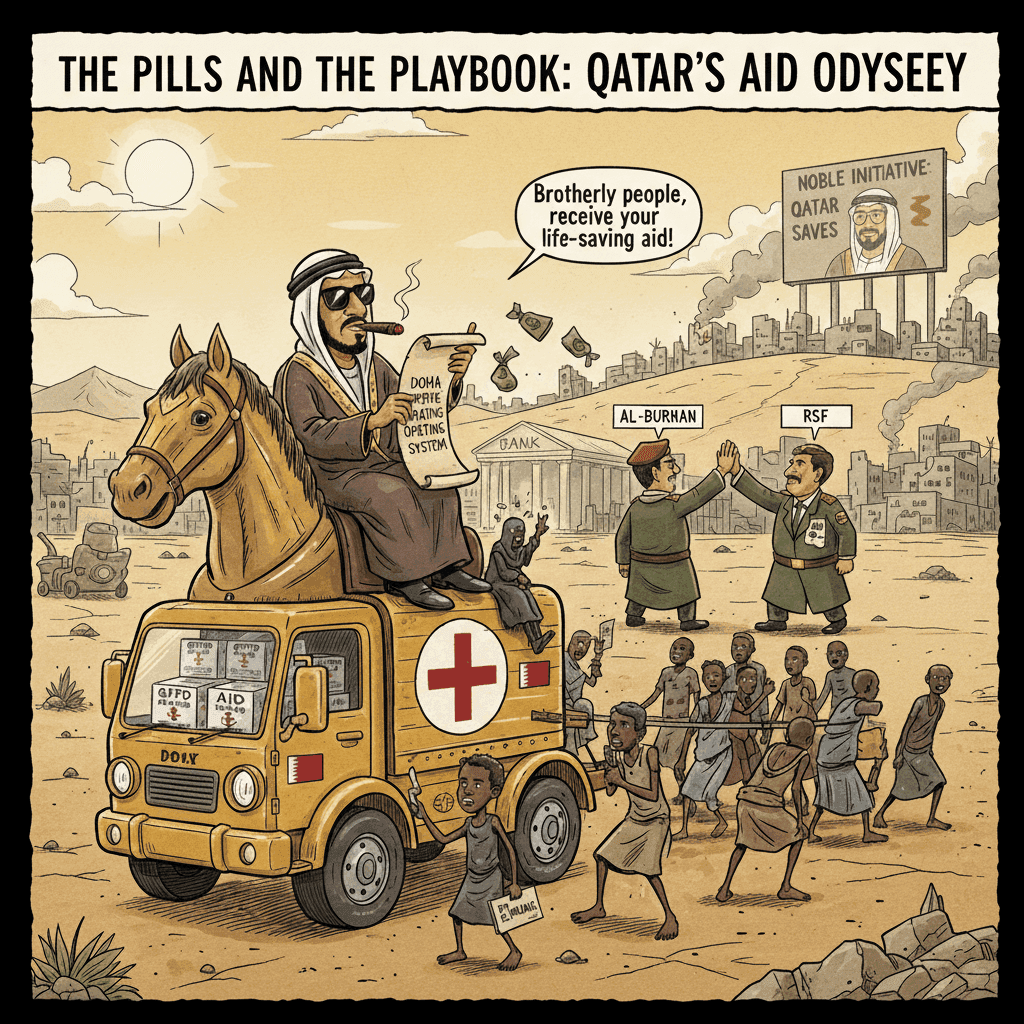
The Gaslighting of the Gulf: Qatar Discovers Pacifism (The Second Their Pipelines Catch Fire)

Welcome back to the Geopolitical Theater of the Absurd, where the rules of international conflict are written in pencil, heavily redacted by lobbyists, and completely inverted the absolute second the State of Qatar feels a slight breeze against its bank account.

If you want to witness the greatest vanishing act in the history of modern diplomacy, you do not need to travel to Las Vegas to see David Copperfield. You only need to look at the sudden, miraculous disappearance of Qatar’s appetite for “holy resistance.”

For decades, the Qatari ruling elite has operated as the world’s most well-funded arsonists. They have poured billions of dollars into the ideological and military infrastructure of radical Islamist groups across the Middle East. They built the stadium, they funded the teams, they paid the referees, and they broadcast the matches live on Al Jazeera. They reveled in the chaos. But this week, a profound and terrifying reality finally breached the mahogany-lined walls of the Emiri Diwan in Doha: the war they helped start has finally reached the Persian Gulf energy sector.

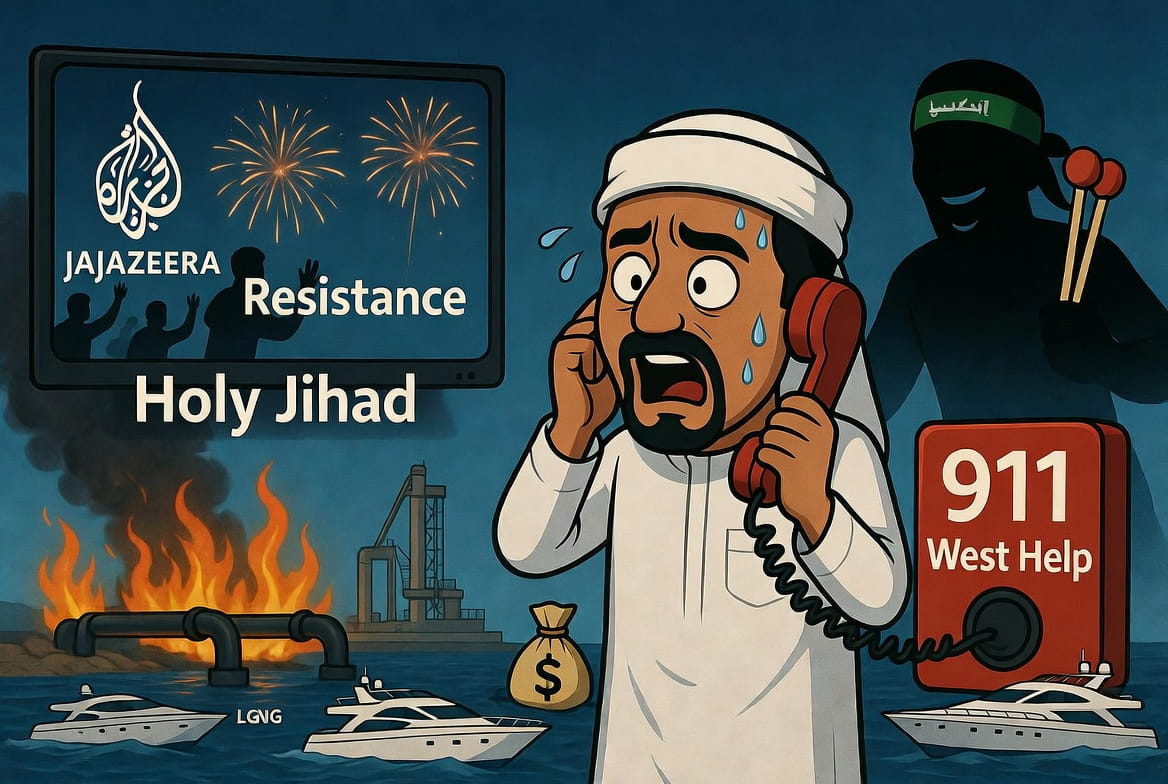
And suddenly, the arsonists are frantically dialing 911, screaming that the fire is an existential threat to humanity.

Following recent kinetic strikes against critical Gulf energy infrastructure, the Qatari Prime Minister rushed to the microphones with a newfound, breathless sense of apocalyptic urgency. The message was no longer about “context.” It was no longer about “nuance.” It was no longer about “the legitimate grievances of the resistance.”

The new message, delivered with the panicked sweat of a man whose luxury yacht is taking on water, was simple: “This war must be stopped immediately.”

Not tomorrow. Not after a negotiated settlement in Geneva. Immediately. We at That’s Qatarted! are connoisseurs of hypocrisy. We study it, we document it, and we marvel at its boundless depths. But the absolute, unmitigated gall required for the State of Qatar to suddenly play the role of the frantic peacemaker—only after their own regional ATM is threatened—is a masterpiece that belongs in the Louvre of gaslighting. Let us take a deep, comprehensive dive into the anatomy of this spectacular double standard.

The Epiphany of the ATM

To truly understand the comedy of the Qatari Prime Minister’s sudden panic, we must contrast it with Doha’s behavior over the last several years.

When Hamas - a terror syndicate wholly subsidized, sheltered, and politically directed by Qatar - launched an unprecedented campaign of mass slaughter, rape, and kidnapping against Israeli civilians, did the Qatari Prime Minister rush to a podium and demand that the violence be “stopped immediately”?

Absolutely not.

When Jewish civilians were being pulled from their beds, the Qatari diplomatic machine shifted into its patented “Diplomacy of Delay” gear. They released sterilized, victim-blaming statements urging “all parties to exercise maximum restraint.” They dispatched their impeccably tailored envoys to Western capitals to lecture the world about the “root causes” of the violence. They argued, with a straight face, that Israel’s military response was an “unacceptable escalation” that ignored the historical context of the region.

To the Qatari elite, the shedding of Israeli blood was not an emergency. It was leverage. It was an opportunity to position themselves as the “indispensable mediators,” extorting diplomatic concessions from the United States while their billionaire Hamas guests ordered room service at the Sheraton in Doha.

But what happens when the theater of war shifts? What happens when the missiles and drones are no longer falling on Sderot or Tel Aviv, but are suddenly striking the vital energy arteries of the Persian Gulf?

The “root causes” vanish into the desert air.

The moment a kinetic strike hits a regional oil refinery or an LNG terminal, the Qatari leadership suffers a catastrophic allergic reaction to their own geopolitical philosophy. When the violence threatens the Qatari bottom line, there is no more talk of “context.” There is only an hysterical, pearl-clutching demand that the international community intervene to protect the sacred infrastructure of the Gulf monarchies.

They are the ultimate fair-weather fanatics. They love the jihad when it is happening in someone else’s backyard. But the second the “axis of resistance” threatens the supply chains that fund their Louis Vuitton boutiques and their Ivy League endowment bribes, they suddenly sound like a coalition of Quaker pacifists.

Houthi Hypocrisy

The hypocrisy becomes even more grotesque when we examine Qatar’s recent posture regarding global shipping and international trade.

For the better part of two years, the Iranian-backed Houthi militia in Yemen has been systematically terrorizing the Red Sea. They have fired anti-ship ballistic missiles at civilian freighters, kidnapped international sailors, and forced the world’s largest shipping conglomerates to reroute their vessels thousands of miles around the Horn of Africa. This campaign of maritime terrorism has choked global supply chains, driving up inflation and hurting the poorest nations on Earth.

And what was Qatar’s official stance on this crippling of the global economy?

Through their state-run media apparatus and their diplomatic proxies, Qatar essentially acted as the Houthis’ defense attorney. They continually pushed the narrative that the Houthi blockade was a “natural consequence” of the war in Gaza. They warned the United States and the United Kingdom against striking Houthi launch sites, claiming that military action would only “widen the conflict.”

Qatar was perfectly content to watch the global economy suffer, because the disruption applied political pressure on the West to force Israel into a premature ceasefire. They treated the Red Sea crisis as a useful geopolitical tool.

But today, the script has been violently flipped. The attacks are no longer confined to the Bab-el-Mandeb strait. They have reached the Gulf energy sector. And suddenly, the Qatari Prime Minister is warning the world of the catastrophic, unthinkable economic consequences of allowing this war to continue for even one more day.

“This war must be stopped immediately!” he cries, implicitly begging the American and European navies to rush to the defense of the Gulf.

When the Houthis choked European trade to defend Hamas, Qatar called it “context.” When attacks hit Gulf energy facilities and threaten Qatari revenue, Qatar calls it an international emergency requiring immediate Western intervention. It is the Geopolitical Munchausen Syndrome in its purest form: they create the disease, sponsor the pathogens, and then scream for the doctors the moment they catch a mild fever.

The Al-Jazeera Disconnect

No analysis of Qatari statecraft is complete without examining their primary weapon of mass deception: Al Jazeera.

If you want to measure the sheer schizophrenia of the Qatari state, you only need to put a television screen broadcasting Al Jazeera Arabic next to a screen showing the Qatari Prime Minister speaking to Western diplomats.

On Al Jazeera Arabic, the war is an unending, glorious holy struggle. The network pumps highly addictive ideological narcotics directly into the veins of the Arab street 24 hours a day. It glorifies “martyrs,” it praises the “resistance,” and it continuously incites the masses to rise up against the West and its regional allies. It is a multi-billion-dollar psychological operations apparatus designed to ensure that the Middle East remains radicalized, angry, and permanently boiling.

Yet, while his state-funded television network is actively cheerleading for the destruction of the Western world order, the Qatari Prime Minister puts on a bespoke suit, stares into the camera of a European news agency, and begs the West to stop the war to protect global energy markets.

He wants the United States to protect the very infrastructure that funds the television network that tells the Arab world to hate the United States.

It is a grift of such staggering proportions that one almost has to admire the sheer sociopathy of it. They are selling the matches, pouring the gasoline, broadcasting the fire, and then charging the fire department a premium to use their fire hydrant.

Holding the World Hostage – Again

Why is the Qatari Prime Minister issuing these desperate demands now? It is not because he has suddenly discovered a deep, abiding love for human life or regional stability. It is because he is deploying the final, most cynical tool in the Qatari playbook: The Energy Hostage Strategy.

Qatar knows that the Western political elite, particularly in Europe, are uniquely vulnerable to energy shocks. European politicians are terrified of inflation, terrified of winter heating bills, and terrified of their own voters.

By running to the press and loudly declaring that the war “must be stopped immediately” due to attacks on Gulf energy, Qatar is purposefully inducing panic in the Western markets. They are signaling to Brussels, London, and Washington: If you do not force Israel to stop dismantling our Islamist allies in the region, your gas prices are going to skyrocket, your economies will crash, and your political careers will be over. They are weaponizing the vulnerability of the global energy supply chain to save the “Axis of Resistance” from total defeat.

Qatar realizes that their primary regional ally - the Islamic Republic of Iran - is currently taking a historic beating. The proxy network that Tehran and Doha spent decades building is being systematically dismantled. Hamas is in ruins. Hezbollah’s leadership is decimated. And now, the kinetic strikes are inching closer and closer to the very energy infrastructure that keeps the Gulf monarchs in power.

The Qatari Prime Minister’s plea is not a call for peace. It is a desperate SOS to the West to save the Islamist political project before it is entirely uprooted. He is using the threat of an energy crisis to blackmail the free world into saving the radical world.

The Cowardice of the Middleman

In the tribal, unforgiving culture of the real Middle East, respect is earned through strength, honor, and a willingness to stand behind your actions.

Qatar has none of these things. They are a nation of middlemen. They thought they had achieved the ultimate geopolitical hack: they believed they could fund the most violent, disruptive forces on the planet, completely insulate themselves from the consequences, and then charge a “mediation fee” when the violence inevitably spilled over.

They truly believed that their endless wealth, their Ivy League university endowments, and their slick public relations campaigns made them untouchable. They thought they could domesticate the monsters of the Middle East.

But the monsters are off the leash. The war has escaped the neat, controllable boundaries that Qatar envisioned. The violence is no longer safely contained to the Levant; it is threatening the very pipelines and export terminals that give Qatar its power.

And the absolute second the reality of this war breached their comfort zone, the Qatari facade crumbled. The tough-talking sponsors of “resistance” immediately ran behind the skirt of the international community, begging the Americans to stop the fighting.

They are the neighborhood bully who throws rocks at windows from behind a fence, only to call the police the moment someone walks through their front gate.

The international community must not fall for this desperate, pathetic ploy. For too long, the West has allowed Qatar to play both sides of the table, turning a blind eye to their financing of terror in exchange for natural gas and empty diplomatic promises.

If Qatar’s energy infrastructure is threatened, it is a consequence of the very regional instability they have spent decades cultivating. You cannot feed the crocodile for twenty years and then complain to the United Nations when it finally decides to snap at your own leg.

The war will stop when the forces of radical Islamism - the very forces Qatar has nurtured and protected - are defeated. Until then, the Qatari Prime Minister can sweat in his mahogany office and contemplate the terrifying reality that in the Middle East, you eventually reap exactly what you sow.

That’s Qatarted!
The Gaslighting of the Gulf: Qatar Discovers Pacifism (The Second Their Pipelines Catch Fire)

Welcome back to the Geopolitical Theater of the Absurd, where the rules of international conflict are written in pencil, heavily redacted by lobbyists, and completely inverted the absolute second the State of Qatar feels a slight breeze against its bank account.

If you want to witness the greatest vanishing act in the history of modern diplomacy, you do not need to travel to Las Vegas to see David Copperfield. You only need to look at the sudden, miraculous disappearance of Qatar’s appetite for “holy resistance.”

For decades, the Qatari ruling elite has operated as the world’s most well-funded arsonists. They have poured billions of dollars into the ideological and military infrastructure of radical Islamist groups across the Middle East. They built the stadium, they funded the teams, they paid the referees, and they broadcast the matches live on Al Jazeera. They reveled in the chaos. But this week, a profound and terrifying reality finally breached the mahogany-lined walls of the Emiri Diwan in Doha: the war they helped start has finally reached the Persian Gulf energy sector.

And suddenly, the arsonists are frantically dialing 911, screaming that the fire is an existential threat to humanity.

Following recent kinetic strikes against critical Gulf energy infrastructure, the Qatari Prime Minister rushed to the microphones with a newfound, breathless sense of apocalyptic urgency. The message was no longer about “context.” It was no longer about “nuance.” It was no longer about “the legitimate grievances of the resistance.”

The new message, delivered with the panicked sweat of a man whose luxury yacht is taking on water, was simple: “This war must be stopped immediately.”

Not tomorrow. Not after a negotiated settlement in Geneva. Immediately. We at That’s Qatarted! are connoisseurs of hypocrisy. We study it, we document it, and we marvel at its boundless depths. But the absolute, unmitigated gall required for the State of Qatar to suddenly play the role of the frantic peacemaker—only after their own regional ATM is threatened—is a masterpiece that belongs in the Louvre of gaslighting. Let us take a deep, comprehensive dive into the anatomy of this spectacular double standard.

The Epiphany of the ATM

To truly understand the comedy of the Qatari Prime Minister’s sudden panic, we must contrast it with Doha’s behavior over the last several years.

When Hamas - a terror syndicate wholly subsidized, sheltered, and politically directed by Qatar - launched an unprecedented campaign of mass slaughter, rape, and kidnapping against Israeli civilians, did the Qatari Prime Minister rush to a podium and demand that the violence be “stopped immediately”?

Absolutely not.

When Jewish civilians were being pulled from their beds, the Qatari diplomatic machine shifted into its patented “Diplomacy of Delay” gear. They released sterilized, victim-blaming statements urging “all parties to exercise maximum restraint.” They dispatched their impeccably tailored envoys to Western capitals to lecture the world about the “root causes” of the violence. They argued, with a straight face, that Israel’s military response was an “unacceptable escalation” that ignored the historical context of the region.

To the Qatari elite, the shedding of Israeli blood was not an emergency. It was leverage. It was an opportunity to position themselves as the “indispensable mediators,” extorting diplomatic concessions from the United States while their billionaire Hamas guests ordered room service at the Sheraton in Doha.

But what happens when the theater of war shifts? What happens when the missiles and drones are no longer falling on Sderot or Tel Aviv, but are suddenly striking the vital energy arteries of the Persian Gulf?

The “root causes” vanish into the desert air.

The moment a kinetic strike hits a regional oil refinery or an LNG terminal, the Qatari leadership suffers a catastrophic allergic reaction to their own geopolitical philosophy. When the violence threatens the Qatari bottom line, there is no more talk of “context.” There is only an hysterical, pearl-clutching demand that the international community intervene to protect the sacred infrastructure of the Gulf monarchies.

They are the ultimate fair-weather fanatics. They love the jihad when it is happening in someone else’s backyard. But the second the “axis of resistance” threatens the supply chains that fund their Louis Vuitton boutiques and their Ivy League endowment bribes, they suddenly sound like a coalition of Quaker pacifists.

Houthi Hypocrisy

The hypocrisy becomes even more grotesque when we examine Qatar’s recent posture regarding global shipping and international trade.

For the better part of two years, the Iranian-backed Houthi militia in Yemen has been systematically terrorizing the Red Sea. They have fired anti-ship ballistic missiles at civilian freighters, kidnapped international sailors, and forced the world’s largest shipping conglomerates to reroute their vessels thousands of miles around the Horn of Africa. This campaign of maritime terrorism has choked global supply chains, driving up inflation and hurting the poorest nations on Earth.

And what was Qatar’s official stance on this crippling of the global economy?

Through their state-run media apparatus and their diplomatic proxies, Qatar essentially acted as the Houthis’ defense attorney. They continually pushed the narrative that the Houthi blockade was a “natural consequence” of the war in Gaza. They warned the United States and the United Kingdom against striking Houthi launch sites, claiming that military action would only “widen the conflict.”

Qatar was perfectly content to watch the global economy suffer, because the disruption applied political pressure on the West to force Israel into a premature ceasefire. They treated the Red Sea crisis as a useful geopolitical tool.

But today, the script has been violently flipped. The attacks are no longer confined to the Bab-el-Mandeb strait. They have reached the Gulf energy sector. And suddenly, the Qatari Prime Minister is warning the world of the catastrophic, unthinkable economic consequences of allowing this war to continue for even one more day.

“This war must be stopped immediately!” he cries, implicitly begging the American and European navies to rush to the defense of the Gulf.

When the Houthis choked European trade to defend Hamas, Qatar called it “context.” When attacks hit Gulf energy facilities and threaten Qatari revenue, Qatar calls it an international emergency requiring immediate Western intervention. It is the Geopolitical Munchausen Syndrome in its purest form: they create the disease, sponsor the pathogens, and then scream for the doctors the moment they catch a mild fever.

The Al-Jazeera Disconnect

No analysis of Qatari statecraft is complete without examining their primary weapon of mass deception: Al Jazeera.

If you want to measure the sheer schizophrenia of the Qatari state, you only need to put a television screen broadcasting Al Jazeera Arabic next to a screen showing the Qatari Prime Minister speaking to Western diplomats.

On Al Jazeera Arabic, the war is an unending, glorious holy struggle. The network pumps highly addictive ideological narcotics directly into the veins of the Arab street 24 hours a day. It glorifies “martyrs,” it praises the “resistance,” and it continuously incites the masses to rise up against the West and its regional allies. It is a multi-billion-dollar psychological operations apparatus designed to ensure that the Middle East remains radicalized, angry, and permanently boiling.

Yet, while his state-funded television network is actively cheerleading for the destruction of the Western world order, the Qatari Prime Minister puts on a bespoke suit, stares into the camera of a European news agency, and begs the West to stop the war to protect global energy markets.

He wants the United States to protect the very infrastructure that funds the television network that tells the Arab world to hate the United States.

It is a grift of such staggering proportions that one almost has to admire the sheer sociopathy of it. They are selling the matches, pouring the gasoline, broadcasting the fire, and then charging the fire department a premium to use their fire hydrant.

Holding the World Hostage – Again

Why is the Qatari Prime Minister issuing these desperate demands now? It is not because he has suddenly discovered a deep, abiding love for human life or regional stability. It is because he is deploying the final, most cynical tool in the Qatari playbook: The Energy Hostage Strategy.

Qatar knows that the Western political elite, particularly in Europe, are uniquely vulnerable to energy shocks. European politicians are terrified of inflation, terrified of winter heating bills, and terrified of their own voters.

By running to the press and loudly declaring that the war “must be stopped immediately” due to attacks on Gulf energy, Qatar is purposefully inducing panic in the Western markets. They are signaling to Brussels, London, and Washington: If you do not force Israel to stop dismantling our Islamist allies in the region, your gas prices are going to skyrocket, your economies will crash, and your political careers will be over. They are weaponizing the vulnerability of the global energy supply chain to save the “Axis of Resistance” from total defeat.

Qatar realizes that their primary regional ally - the Islamic Republic of Iran - is currently taking a historic beating. The proxy network that Tehran and Doha spent decades building is being systematically dismantled. Hamas is in ruins. Hezbollah’s leadership is decimated. And now, the kinetic strikes are inching closer and closer to the very energy infrastructure that keeps the Gulf monarchs in power.

The Qatari Prime Minister’s plea is not a call for peace. It is a desperate SOS to the West to save the Islamist political project before it is entirely uprooted. He is using the threat of an energy crisis to blackmail the free world into saving the radical world.

The Cowardice of the Middleman

In the tribal, unforgiving culture of the real Middle East, respect is earned through strength, honor, and a willingness to stand behind your actions.

Qatar has none of these things. They are a nation of middlemen. They thought they had achieved the ultimate geopolitical hack: they believed they could fund the most violent, disruptive forces on the planet, completely insulate themselves from the consequences, and then charge a “mediation fee” when the violence inevitably spilled over.

They truly believed that their endless wealth, their Ivy League university endowments, and their slick public relations campaigns made them untouchable. They thought they could domesticate the monsters of the Middle East.

But the monsters are off the leash. The war has escaped the neat, controllable boundaries that Qatar envisioned. The violence is no longer safely contained to the Levant; it is threatening the very pipelines and export terminals that give Qatar its power.

And the absolute second the reality of this war breached their comfort zone, the Qatari facade crumbled. The tough-talking sponsors of “resistance” immediately ran behind the skirt of the international community, begging the Americans to stop the fighting.

They are the neighborhood bully who throws rocks at windows from behind a fence, only to call the police the moment someone walks through their front gate.

The international community must not fall for this desperate, pathetic ploy. For too long, the West has allowed Qatar to play both sides of the table, turning a blind eye to their financing of terror in exchange for natural gas and empty diplomatic promises.

If Qatar’s energy infrastructure is threatened, it is a consequence of the very regional instability they have spent decades cultivating. You cannot feed the crocodile for twenty years and then complain to the United Nations when it finally decides to snap at your own leg.

The war will stop when the forces of radical Islamism - the very forces Qatar has nurtured and protected - are defeated. Until then, the Qatari Prime Minister can sweat in his mahogany office and contemplate the terrifying reality that in the Middle East, you eventually reap exactly what you sow.

That’s Qatarted!
The Gaslighting of the Gulf: Qatar Discovers Pacifism (The Second Their Pipelines Catch Fire)

Welcome back to the Geopolitical Theater of the Absurd, where the rules of international conflict are written in pencil, heavily redacted by lobbyists, and completely inverted the absolute second the State of Qatar feels a slight breeze against its bank account.

If you want to witness the greatest vanishing act in the history of modern diplomacy, you do not need to travel to Las Vegas to see David Copperfield. You only need to look at the sudden, miraculous disappearance of Qatar’s appetite for “holy resistance.”

For decades, the Qatari ruling elite has operated as the world’s most well-funded arsonists. They have poured billions of dollars into the ideological and military infrastructure of radical Islamist groups across the Middle East. They built the stadium, they funded the teams, they paid the referees, and they broadcast the matches live on Al Jazeera. They reveled in the chaos. But this week, a profound and terrifying reality finally breached the mahogany-lined walls of the Emiri Diwan in Doha: the war they helped start has finally reached the Persian Gulf energy sector.

And suddenly, the arsonists are frantically dialing 911, screaming that the fire is an existential threat to humanity.

Following recent kinetic strikes against critical Gulf energy infrastructure, the Qatari Prime Minister rushed to the microphones with a newfound, breathless sense of apocalyptic urgency. The message was no longer about “context.” It was no longer about “nuance.” It was no longer about “the legitimate grievances of the resistance.”

The new message, delivered with the panicked sweat of a man whose luxury yacht is taking on water, was simple: “This war must be stopped immediately.”

Not tomorrow. Not after a negotiated settlement in Geneva. Immediately. We at That’s Qatarted! are connoisseurs of hypocrisy. We study it, we document it, and we marvel at its boundless depths. But the absolute, unmitigated gall required for the State of Qatar to suddenly play the role of the frantic peacemaker—only after their own regional ATM is threatened—is a masterpiece that belongs in the Louvre of gaslighting. Let us take a deep, comprehensive dive into the anatomy of this spectacular double standard.

The Epiphany of the ATM

To truly understand the comedy of the Qatari Prime Minister’s sudden panic, we must contrast it with Doha’s behavior over the last several years.

When Hamas - a terror syndicate wholly subsidized, sheltered, and politically directed by Qatar - launched an unprecedented campaign of mass slaughter, rape, and kidnapping against Israeli civilians, did the Qatari Prime Minister rush to a podium and demand that the violence be “stopped immediately”?

Absolutely not.

When Jewish civilians were being pulled from their beds, the Qatari diplomatic machine shifted into its patented “Diplomacy of Delay” gear. They released sterilized, victim-blaming statements urging “all parties to exercise maximum restraint.” They dispatched their impeccably tailored envoys to Western capitals to lecture the world about the “root causes” of the violence. They argued, with a straight face, that Israel’s military response was an “unacceptable escalation” that ignored the historical context of the region.

To the Qatari elite, the shedding of Israeli blood was not an emergency. It was leverage. It was an opportunity to position themselves as the “indispensable mediators,” extorting diplomatic concessions from the United States while their billionaire Hamas guests ordered room service at the Sheraton in Doha.

But what happens when the theater of war shifts? What happens when the missiles and drones are no longer falling on Sderot or Tel Aviv, but are suddenly striking the vital energy arteries of the Persian Gulf?

The “root causes” vanish into the desert air.

The moment a kinetic strike hits a regional oil refinery or an LNG terminal, the Qatari leadership suffers a catastrophic allergic reaction to their own geopolitical philosophy. When the violence threatens the Qatari bottom line, there is no more talk of “context.” There is only an hysterical, pearl-clutching demand that the international community intervene to protect the sacred infrastructure of the Gulf monarchies.

They are the ultimate fair-weather fanatics. They love the jihad when it is happening in someone else’s backyard. But the second the “axis of resistance” threatens the supply chains that fund their Louis Vuitton boutiques and their Ivy League endowment bribes, they suddenly sound like a coalition of Quaker pacifists.

Houthi Hypocrisy

The hypocrisy becomes even more grotesque when we examine Qatar’s recent posture regarding global shipping and international trade.

For the better part of two years, the Iranian-backed Houthi militia in Yemen has been systematically terrorizing the Red Sea. They have fired anti-ship ballistic missiles at civilian freighters, kidnapped international sailors, and forced the world’s largest shipping conglomerates to reroute their vessels thousands of miles around the Horn of Africa. This campaign of maritime terrorism has choked global supply chains, driving up inflation and hurting the poorest nations on Earth.

And what was Qatar’s official stance on this crippling of the global economy?

Through their state-run media apparatus and their diplomatic proxies, Qatar essentially acted as the Houthis’ defense attorney. They continually pushed the narrative that the Houthi blockade was a “natural consequence” of the war in Gaza. They warned the United States and the United Kingdom against striking Houthi launch sites, claiming that military action would only “widen the conflict.”

Qatar was perfectly content to watch the global economy suffer, because the disruption applied political pressure on the West to force Israel into a premature ceasefire. They treated the Red Sea crisis as a useful geopolitical tool.

But today, the script has been violently flipped. The attacks are no longer confined to the Bab-el-Mandeb strait. They have reached the Gulf energy sector. And suddenly, the Qatari Prime Minister is warning the world of the catastrophic, unthinkable economic consequences of allowing this war to continue for even one more day.

“This war must be stopped immediately!” he cries, implicitly begging the American and European navies to rush to the defense of the Gulf.

When the Houthis choked European trade to defend Hamas, Qatar called it “context.” When attacks hit Gulf energy facilities and threaten Qatari revenue, Qatar calls it an international emergency requiring immediate Western intervention. It is the Geopolitical Munchausen Syndrome in its purest form: they create the disease, sponsor the pathogens, and then scream for the doctors the moment they catch a mild fever.

The Al-Jazeera Disconnect

No analysis of Qatari statecraft is complete without examining their primary weapon of mass deception: Al Jazeera.

If you want to measure the sheer schizophrenia of the Qatari state, you only need to put a television screen broadcasting Al Jazeera Arabic next to a screen showing the Qatari Prime Minister speaking to Western diplomats.

On Al Jazeera Arabic, the war is an unending, glorious holy struggle. The network pumps highly addictive ideological narcotics directly into the veins of the Arab street 24 hours a day. It glorifies “martyrs,” it praises the “resistance,” and it continuously incites the masses to rise up against the West and its regional allies. It is a multi-billion-dollar psychological operations apparatus designed to ensure that the Middle East remains radicalized, angry, and permanently boiling.

Yet, while his state-funded television network is actively cheerleading for the destruction of the Western world order, the Qatari Prime Minister puts on a bespoke suit, stares into the camera of a European news agency, and begs the West to stop the war to protect global energy markets.

He wants the United States to protect the very infrastructure that funds the television network that tells the Arab world to hate the United States.

It is a grift of such staggering proportions that one almost has to admire the sheer sociopathy of it. They are selling the matches, pouring the gasoline, broadcasting the fire, and then charging the fire department a premium to use their fire hydrant.

Holding the World Hostage – Again

Why is the Qatari Prime Minister issuing these desperate demands now? It is not because he has suddenly discovered a deep, abiding love for human life or regional stability. It is because he is deploying the final, most cynical tool in the Qatari playbook: The Energy Hostage Strategy.

Qatar knows that the Western political elite, particularly in Europe, are uniquely vulnerable to energy shocks. European politicians are terrified of inflation, terrified of winter heating bills, and terrified of their own voters.

By running to the press and loudly declaring that the war “must be stopped immediately” due to attacks on Gulf energy, Qatar is purposefully inducing panic in the Western markets. They are signaling to Brussels, London, and Washington: If you do not force Israel to stop dismantling our Islamist allies in the region, your gas prices are going to skyrocket, your economies will crash, and your political careers will be over. They are weaponizing the vulnerability of the global energy supply chain to save the “Axis of Resistance” from total defeat.

Qatar realizes that their primary regional ally - the Islamic Republic of Iran - is currently taking a historic beating. The proxy network that Tehran and Doha spent decades building is being systematically dismantled. Hamas is in ruins. Hezbollah’s leadership is decimated. And now, the kinetic strikes are inching closer and closer to the very energy infrastructure that keeps the Gulf monarchs in power.

The Qatari Prime Minister’s plea is not a call for peace. It is a desperate SOS to the West to save the Islamist political project before it is entirely uprooted. He is using the threat of an energy crisis to blackmail the free world into saving the radical world.

The Cowardice of the Middleman

In the tribal, unforgiving culture of the real Middle East, respect is earned through strength, honor, and a willingness to stand behind your actions.

Qatar has none of these things. They are a nation of middlemen. They thought they had achieved the ultimate geopolitical hack: they believed they could fund the most violent, disruptive forces on the planet, completely insulate themselves from the consequences, and then charge a “mediation fee” when the violence inevitably spilled over.

They truly believed that their endless wealth, their Ivy League university endowments, and their slick public relations campaigns made them untouchable. They thought they could domesticate the monsters of the Middle East.

But the monsters are off the leash. The war has escaped the neat, controllable boundaries that Qatar envisioned. The violence is no longer safely contained to the Levant; it is threatening the very pipelines and export terminals that give Qatar its power.

And the absolute second the reality of this war breached their comfort zone, the Qatari facade crumbled. The tough-talking sponsors of “resistance” immediately ran behind the skirt of the international community, begging the Americans to stop the fighting.

They are the neighborhood bully who throws rocks at windows from behind a fence, only to call the police the moment someone walks through their front gate.

The international community must not fall for this desperate, pathetic ploy. For too long, the West has allowed Qatar to play both sides of the table, turning a blind eye to their financing of terror in exchange for natural gas and empty diplomatic promises.

If Qatar’s energy infrastructure is threatened, it is a consequence of the very regional instability they have spent decades cultivating. You cannot feed the crocodile for twenty years and then complain to the United Nations when it finally decides to snap at your own leg.

The war will stop when the forces of radical Islamism - the very forces Qatar has nurtured and protected - are defeated. Until then, the Qatari Prime Minister can sweat in his mahogany office and contemplate the terrifying reality that in the Middle East, you eventually reap exactly what you sow.

That’s Qatarted!
Mar 25, 2026

10 min read

THE CARTEL OF CHAOS: QATAR LECTURES THE WORLD ON DRUGS WHILE SMUGGLING IDEOLOGICAL NARCOTICS

Welcome back to the Geopolitical Theater of the Absurd, where the world’s most prolific sponsors of ideological radicalism put on bespoke Italian suits, fly private jets to European capitals, and lecture the rest of us on moral purity.

If you want to witness a masterclass in parasitic statecraft, absolute cognitive dissonance, and the kind of staggering hypocrisy that could bend the laws of physics, look no further than the latest dispatch from the state-run Qatar Tribune.

The headline reads like an Onion article that accidentally made it to the printing press: “Qatar affirms commitment to boosting intl cooperation against world’s drug problem.”

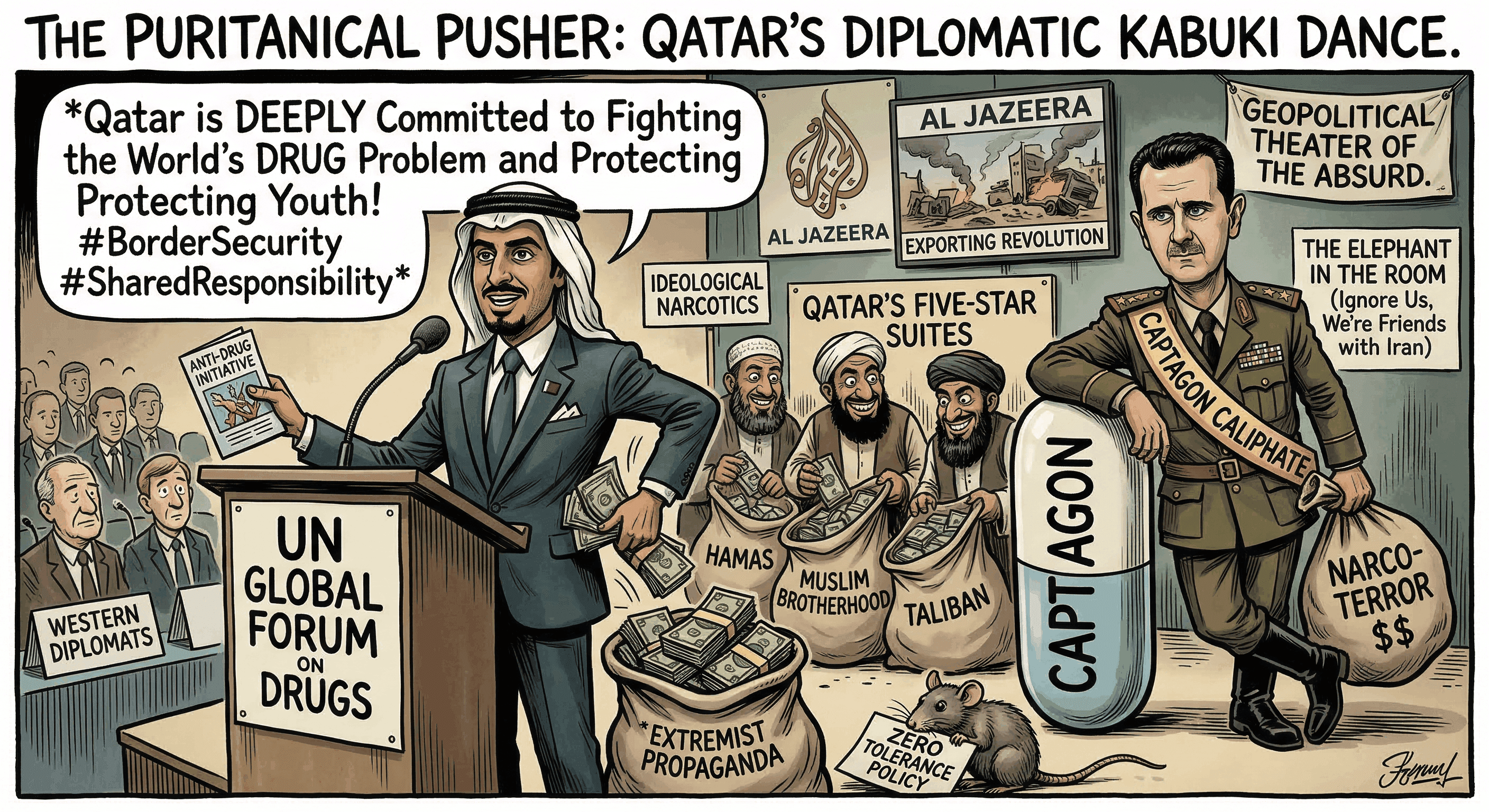
Yes, you read that correctly. The State of Qatar—the geopolitical sugar daddy of the Muslim Brotherhood, the luxury concierge for Hamas, and the diplomatic shield for the Taliban—recently stood before the international community to express its deep, unwavering, and profound concern about... narcotics.

According to the official state propaganda, Qatari diplomats recently took to the podium at a global forum to boast about their “comprehensive and multidisciplinary approach” to fighting the global drug trade. They pontificated about the necessity of “shared responsibility,” the importance of “border security,” and their noble dedication to protecting the youth from the ravages of addiction.

Qatar pretending to care about the global drug problem is the geopolitical equivalent of Al Capone lecturing the local PTA on the dangers of jaywalking. It is a spectacular, breathtaking grift. And we at That’s Qatarted! are here to dissect exactly how the Primadonna of the Persian Gulf uses this bureaucratic theater to gaslight the entire planet.

Grab your coffee and settle in. We are going to take a very long, very deep dive into the anatomy of a geopolitical cartel.

THE DIPLOMATIC KABUKI DANCE

To truly appreciate the absurdity of the Qatari position, you have to picture the scene. Imagine the mahogany-lined halls of an international UN convention in Vienna or Geneva. The air is thick with expensive cologne and the meaningless, sterilized buzzwords of global diplomacy.

A Qatari diplomat, impeccably dressed, steps to the microphone. He looks out at the assembly of international law enforcement officials and NGOs, and with a completely straight face, declares that the State of Qatar is deeply committed to “combating the transnational networks that threaten global security and stability.”

The absolute gall. The unmitigated, staggering hubris.

Let us decode the diplomatic doublespeak. When Qatar talks about “border security” and stopping “transnational networks,” what they actually mean is that they are highly efficient at arresting a terrified, underpaid migrant worker from South Asia who accidentally brought a bottle of codeine cough syrup through Hamad International Airport. They will throw the book at a transit passenger for possessing half a gram of hashish, citing their absolute zero-tolerance policy for illicit substances. They will parade this statistic around the United Nations as proof of their unwavering moral fortitude.

But what happens when the “transnational network” isn’t a low-level weed smuggler, but a multi-billion dollar terror syndicate?

Suddenly, Qatar’s “zero-tolerance” policy evaporates into the desert wind. Suddenly, they become the champions of “nuance,” “context,” and “diplomatic engagement.”

If you smuggle a joint into Doha, you go to a sweltering prison. If you smuggle Iranian-funded ballistic missiles into Gaza, or orchestrate the hostile takeover of Kabul, or launder hundreds of millions of dollars for the Muslim Brotherhood, Qatar doesn’t arrest you. Qatar gives you a five-star suite at the Sheraton, a diplomatic passport, and a dedicated slot on Al Jazeera to broadcast your manifesto.

They stand before the world and demand international cooperation to stop the trafficking of chemicals, while they actively finance and facilitate the trafficking of human misery, chaos, and terror.

THE CAPTAGON ELEPHANT IN THE ROOM

Let us dig a little deeper into the specific geopolitics of the Middle Eastern drug trade, because the irony here is so thick you could cut it with a scimitar.

If Qatar is so deeply concerned about the “world’s drug problem,” one might assume they are aggressively targeting the largest, most destructive narco-empire in their own backyard.

I am talking, of course, about the Captagon Caliphate.

For the uninitiated, Captagon is a highly addictive amphetamine that has become the financial lifeblood of the “Axis of Resistance.” The regime of Bashar al-Assad in Syria, operating in seamless coordination with the Iranian Islamic Revolutionary Guard Corps (IRGC) and the Lebanese terror group Hezbollah, has transformed the Levant into a massive, state-sponsored cartel. They produce billions of dollars’ worth of Captagon pills and flood them across the borders into Jordan, Saudi Arabia, and the broader Gulf, destroying the lives of millions of Arab youths in the process.

The Assad-Iran-Hezbollah nexus is the Pablo Escobar of the Middle East. They are a literal narco-terrorist syndicate.

And what is Qatar’s relationship with the primary architects of this narco-empire?

As we detailed in previous investigations, Qatar bends over backward to appease Tehran. Qatari Prime Minister Sheikh Mohammed bin Abdulrahman Al Thani recently went on television to declare that Qatar builds its relationship with Iran “in good faith.” Qatar shares the world’s largest natural gas field with Iran. Qatar routinely acts as Iran’s diplomatic defense attorney in Washington, desperately trying to protect the Ayatollah’s regime from American and Israeli military pressure.

So, let’s get this straight. Qatar goes to the United Nations to lecture the globe on the catastrophic dangers of drug smuggling, while simultaneously running interference and providing diplomatic cover for the very regime (Iran) that sponsors the most prolific drug-smuggling terror militia (Hezbollah) on the planet.

Qatar has absolutely no problem with “transnational networks” poisoning the youth of the Middle East, so long as those networks belong to their geopolitical allies. They will condemn the drugs, but they will happily cuddle the drug lords. It is a masterpiece of geopolitical gaslighting.

The Puritanical Pusher

Ultimately, the most fascinating aspect of this war on drugs is what it reveals about the psychology of the Qatari elite.

How does a state reconcile this extreme duality? How do they enforce brutal, puritanical order at home, while actively funding and fueling chaos, revolution, and destruction abroad?

This is the Paradox of the Puritanical Pusher.

Every successful drug cartel operates on one fundamental rule: Never get high on your own supply.

The Qatari leadership understands this perfectly. Inside the borders of Qatar, there is no revolution. There is no protesting. There is absolutely no tolerance for the kind of radical, destabilizing Islamist agitation that Al Jazeera promotes 24/7 in neighboring countries like Egypt, Syria, or Saudi Arabia. If a Qatari citizen tried to organize a Muslim Brotherhood rally in downtown Doha, or set up a protest encampment demanding the overthrow of the Emir, they would be disappeared into a state security dungeon faster than you can say “Force Majeure.”

Qatar demands absolute, iron-fisted stability at home. They want pristine streets, endless luxury, and a completely docile population.

But for the rest of the world? For the rest of the world, Qatar exports the poison.

They export the ideological narcotics of Islamism to the Arab world to keep their regional rivals weak and distracted. They export the ideological narcotics of “woke” grievance studies to the West to fracture American society and ensure the U.S. remains deeply divided and entirely dependent on Qatari “mediation” to solve the very crises Qatar helped create.

They are the neighborhood drug dealer who lives in a gated mansion, keeps his own children completely isolated from the streets, and then makes his billions by selling crack to the kids on the other side of town.

And then, just to rub salt in the wound, he puts on a suit, drives to the local town hall meeting, and gives a 45-minute speech on his “unwavering commitment to boosting international cooperation against the world’s drug problem.”

It is a level of sociopathic statecraft that borders on art.

The Internation Enablers

The international community sits in these UN forums, clapping politely as the Qatari delegation delivers its meaningless platitudes about fighting the drug trade. The Western diplomats nod along, desperately hoping that if they humor the Emir, maybe Qatar will lower the price of LNG, or maybe they will graciously ask Hamas to release a few of the hostages that Qatar itself helped finance.

The West is playing a bureaucratic game of checkers, while Qatar is playing a multidimensional game of civilizational chess.

Qatar doesn’t care about the global drug problem. They only care about maintaining their status as the indispensable arsonist and the indispensable firefighter. They will continue to arrest the low-level smugglers at their airport to maintain the illusion of law and order, while operating the most sophisticated ideological smuggling ring in the history of the modern world.

They will keep addicting our universities, corrupting our media, and shielding our enemies. And they will do it all with a smile, a bespoke suit, and a perfectly worded press release in the Qatar Tribune.

Mar 25, 2026

7 min read

The Pacificist of the Persian Gulf: Or How the Qataris Discovered “Human Rights” the Second an Iranian Missile Ruined Their Brunch

Welcome back to the Geopolitical Theater of the Absurd, where the death of truth is not just a daily occurrence, but a heavily subsidized state enterprise.

If you want to witness a clinical case study in staggering cognitive dissonance, look no further than the diplomatic pantomime currently playing out in Doha. This week, the Islamic Republic of Iran—the undisputed heavyweight champion of regional destabilization—decided to skip the proxy middlemen and launched a barrage of nine ballistic missiles and a swarm of suicide drones directly at the State of Qatar.

And how did the mighty Qatari regime respond? The same regime that has spent decades acting as the financial concierge for every radical Islamist terror syndicate on the planet? Did they project raw power? Did they unleash a terrifying military retaliation?

No.

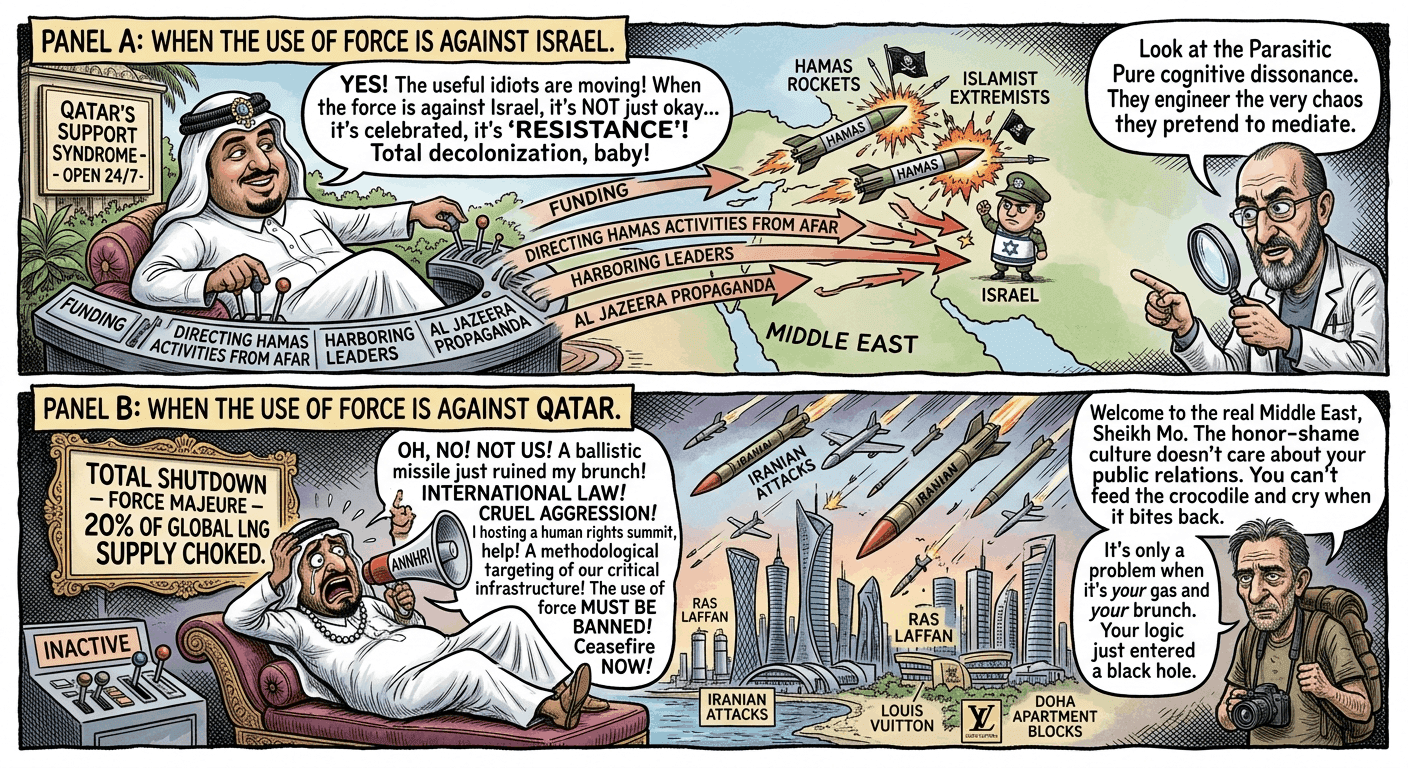
They retreated to a luxury conference room, turned on the microphones, and hosted an urgent meeting of the “Arab Network for National Human Rights Institutions” (ANNHRI) to cry about the “absolute ban on the use of force.”

You simply cannot make this up. The absolute, unmitigated gall required to pull off this level of geopolitical gaslighting is a marvel of human psychology. We at That’s Qatarted! are here to dissect this masterpiece of hypocrisy, strip away the sterilized United Nations jargon, and expose the farcical reality of Qatar’s newfound pacifism.

The Doha Parasite

To truly understand what is happening here, we must diagnose the neurological pathogen infecting the Qatari elite. It is a unique disease of the mind, a parasitic infection that completely obliterates the host’s capacity for self-awareness, logic, and shame. Let us call it the Doha Parasitic Syndrome.

For twenty years, the State of Qatar has operated as the sugar daddy of jihad. They provided five-star hotel suites to the billionaire leaders of Hamas. They funded the Taliban. They bankrolled the Muslim Brotherhood. They utilized their state-run megaphone, Al Jazeera, to pump ideological toxins into the Arab bloodstream, glorifying “martyrs” and framing the mass murder of civilians as “holy resistance.”

When Hamas or Palestinian Islamic Jihad launched tens of thousands of unguided rockets into Israeli cities, did Qatar convene an urgent human rights summit to condemn the “use of force”? Of course not. When the violence was directed at the Jewish state, the Qatari elites viewed the use of force as a divine obligation. It was celebrated. It was the “decolonization” they so gleefully pay American universities to teach.

But the very millisecond the Iranian crocodile turns around and snaps its jaws at Doha? The moment a ballistic missile enters the airspace above the designer boutiques of the Pearl-Qatar?

Suddenly, the Qatari leadership undergoes a miraculous, instantaneous metamorphosis. The financiers of holy war transform into the reincarnations of Mahatma Gandhi. Suddenly, they are clutching their pearls, hyperventilating about “international law,” and pleading with the global community to enforce an “absolute ban on the use of force.”

This is the ultimate murder of truth. They demand that the West applies a strict, utopian set of human rights standards to protect Qatari sovereign airspace, while simultaneously funding the barbarians who explicitly seek to dismantle Western civilization. It is ideological parasitism at its finest: they weaponize the moral compass of the free world to shield themselves from the very monsters they helped create.

The “Real” Middle East versus the Mahogany Suites

Let us cut through the BS and look at this through the lens of the actual, unfiltered Middle East. Not the fantasy version peddled by blue-haired sociology professors in the West, but the raw, unforgiving reality of the Arab world.

In this neighborhood, respect is not earned through nicely worded resolutions or “human rights networks.” This is a region that operates strictly on the tribal dynamics of honor, shame, and the big stick. The strong eat the weak, and the weak pay tribute to survive.

The guys sitting in the shisha cafes in Cairo, Amman, and Baghdad - the real “Arab street” - are looking at Qatar right now and laughing. They know the score. They know that Qatar is a micro-state with a massive bank account and a glass jaw. For years, Qatar thought it could play the regional tough guy by outsourcing its violence. They thought they could buy their way out of the tribal reality by purchasing European soccer teams, bribing Western politicians, and funding radical militias to destabilize their neighbors.

They truly believed their money and their Ivy League connections made them immune to the rules of the jungle.

But Iran just delivered a brutal reality check. Tehran doesn’t care about your investments in London real estate. Tehran doesn’t care about your public relations campaigns. By firing missiles at Doha, the Ayatollahs are asserting dominance the old-fashioned way. They are showing the entire Arab world that when push comes to shove, Qatar is utterly defenseless.

And how does Qatar react to this public humiliation? They whine to international NGOs. In the honor-shame culture of the Middle East, there is nothing more pathetic than a supposed power broker running behind the skirt of the United Nations the moment they get punched in the mouth. The Arab street respects power. Qatar responds to power with press releases.

The Comedy of the “Arab Human Rights” Cabal

We must take a moment to savor the pure, unadulterated comedic genius of the ANNHRI meeting itself.

First of all, the concept of an “Arab Network for National Human Rights Institutions” headquartered in Doha is an oxymoron so profound it threatens to rip a hole in the space-time continuum. Hosting a human rights summit in the Persian Gulf is like hosting a women’s rights convention in Kabul, or a vegan food festival inside a slaughterhouse.

This is a region where journalists are occasionally dismembered for writing critical articles. This is a country where migrant workers are treated as disposable, indentured props to build World Cup stadiums. And yet, there they were, sitting in their air-conditioned conference rooms, talking about “civilian rights” and “humanitarian rules-based orders.”

During the meeting, the Chairman of the network, Eng. Ali Ahmed Al Derazi, condemned the Iranian missile strikes as “full-scale aggression, devoid of ethical or legal justification.”

Let that sink in. The State of Qatar, which has acted as the primary diplomatic shield for the October 7th massacres—an event that was the literal definition of full-scale aggression devoid of ethical justification—is now lecturing the region on ethics.

Another official at the meeting warned of the “risks posed by ongoing cross-border attacks in undermining human rights.”

Where was this profound concern for cross-border attacks when Hezbollah was firing anti-tank missiles into northern Israel every single day for the past two years? Where was this desperate need for “accountability mechanisms” when the Houthis—who are armed by the very same Iranians currently bombing Qatar—were holding the global shipping industry hostage in the Red Sea?

To the Qatari elite, “human rights” is not a moral framework. It is merely a linguistic tool, a fashionable accessory they put on when they need to play the victim, and discard the moment it becomes inconvenient for their Islamist agenda.

The Hypocrisy of “Civilian Infrastructure”

The crowning jewel of the ANNHRI summit was the outrage over the targeting of civilian infrastructure. The participants dramatically condemned the “methodical targeting of critical infrastructure, including energy facilities, airports, and water stations.”

It is truly touching to see Doha suddenly discover the sanctity of civilian infrastructure.

Let’s review the tape. Qatar funds and directs Hamas. Hamas’s entire military doctrine is predicated on building vast subterranean terror networks directly underneath civilian infrastructure. They place their rocket launchers next to schools. They put their command centers under hospitals. They store their ammunition in residential apartment buildings. Qatar knows this. Qatar paid for it. They purposefully subsidized a terror strategy that explicitly uses Palestinian civilians as human shields to maximize the PR value of dead bodies.

But when an Iranian drone gets a little too close to the Hamad International Airport? When a piece of missile debris falls near the industrial zone in Doha?

Suddenly, civilian infrastructure is a sacred, inviolable temple of humanity! Suddenly, the international community must immediately intervene to protect the vital energy facilities of the Qatari state!

The absolute brazenness of it all. They are demanding that the world treats Qatari LNG facilities as untouchable humanitarian zones, while they finance the militarization of every hospital and school in the Gaza Strip. It is a level of sociopathic statecraft that belongs in a textbook.

The Coward Bully

At the end of the day, the ANNHRI meeting in Doha is nothing more than a desperate, cowardly plea for the West to step in and save Qatar from the consequences of its own actions.

For decades, Qatar has played a deadly, duplicitous game. They believed they could be the arsonist and the firefighter simultaneously. They believed they could feed the Iranian crocodile, arm the Islamist extremists, and slowly destabilize the entire region, all while safely hiding behind the American military base at Al Udeid.

They thought they had domesticated the monsters of the Middle East. But the monsters are off the leash, and they are hungry. The ballistic missiles intercepted over Doha are a wake-up call that the Qatari royals cannot comprehend.

Instead of looking in the mirror and realizing that their sponsorship of radicalism has finally come home to roost, they retreat into the semantic nonsense of “human rights” diplomacy. They want the United Nations to write a sternly worded letter to the Ayatollahs. They want “awareness campaigns.”

It is the dying gasp of a failed geopolitical strategy. You cannot preach the absolute ban on the use of force when your entire national brand is built on funding the forceful destruction of others. The world is finally seeing Qatar for what it truly is: a fragile, hypocritical cartel that cries like a victim the moment the violence it sponsors is aimed in its direction.

That’s Qatarted!

Mar 25, 2026

8 min read

THE UMBRELLA OF THE UMMAH: QATAR LECTURES AMERICA WHILE CUDDLING THE AYATOLLAH

Welcome back to the Geopolitical Theater of the Absurd, where the arsonist complains about the smoke, the victim apologizes to the mugger, and the State of Qatar tells the United States military how to do its job.

If you want to witness a masterclass in cognitive dissonance and parasitic statecraft, look no further than the recent Sky News / YouTube interview with Qatari Prime Minister Sheikh Mohammed bin Abdulrahman Al Thani.

Sitting safely in his pristine Doha office—protected by American and British fighter jets—the Prime Minister addressed the recent barrage of Iranian ballistic missiles and drones raining down on his country. And his response? A spectacular, spineless cocktail of fake shock, appeasement, and the audacity to lecture the West.

The “Shocking” Betrayal

Let’s start with the comedy of errors. Speaking about the Iranian missile strikes, Sheikh Mohammed clutched his proverbial pearls and stated: “We never expected this to come to us from our neighbor... we were always building this relationship in preserving the good neighborhood and relationship in a good faith with Iran.”

Stop. Freeze frame.

You didn’t expect this? You, the nation that has spent decades acting as the financial and diplomatic concierge for every radical Islamist terror group in the Middle East, are shocked that the world’s leading state sponsor of terrorism acted like a terrorist state?

Qatar spent years feeding the Iranian crocodile, hoping it would eat them last. They shared the world’s largest gas field, they helped Tehran bypass sanctions, and they happily acted as Hamas’s Sugar Daddy in coordination with the IRGC. But the moment the Ayatollah decides to turn the rockets on Doha, Qatar acts like a betrayed prom date. “But we acted in good faith!” Newsflash to Doha: You cannot build a “good faith” neighborhood watch program with a regime whose entire geopolitical operating system is based on exporting violent Islamic revolution.

The Chihuahua Lectures the Pitbull

But the absolute pinnacle of Qatari delusion comes when the Prime Minister pivots to lecturing the United States and the international community.

Despite the fact that the UK’s RAF and the US military are currently the only things keeping Doha from becoming a smoking crater (a fact the PM casually glided over by mentioning a “joint squadron” with British pilots), Qatar is now demanding that “all sides must de-escalate.”

Wait, what?

Iran launches unprovoked ballistic missiles at your capital, forces your airport to shut down, and threatens 20% of the world’s LNG supply... and your message is that America needs to de-escalate?

Sheikh Mohammed literally stated he wants a diplomatic solution “that addresses our concerns as well as their concerns.” What exactly are Iran’s “concerns” here? That they missed the luxury boutiques at the Pearl-Qatar? That their drones didn’t kill enough expats? The fact that a Qatari leader is validating the “concerns” of a regime that just tried to blow up his country is a testament to the ideological pathogen infecting the Gulf.

He even sent a message to Iran pleading with them not to involve other countries, so that Qatar can “be able to be helped in de-escalating the situation.” Translation: Please stop shooting at us, so we can go back to the UN and defend you against the mean Americans and Israelis.

The Brotherhood of the Ummah

Why is Qatar playing this pathetic double game? Why won’t they come out and unequivocally condemn the Islamic Republic and call for its dismantling?

Because behind closed doors, despite the sectarian window-dressing, Doha and Tehran share the exact same ridiculous, archaic agenda.

Yes, Iran is the vanguard of Shia extremism (Khomeinism), and Qatar is the bankroller of Sunni extremism (the Muslim Brotherhood). To the untrained Western eye, they are mortal enemies. But in reality, they are ideological cousins engaged in a violent family dispute over who gets to sit at the head of the table.

Both regimes fundamentally believe in the supremacy of the Islamic Ummah. Both regimes despise Western secular democracy. Both regimes view Israel as a cancerous tumor that must be eradicated. And both regimes enthusiastically fund Hamas to do the dirty work.

They are two sides of the same Islamist coin. Qatar doesn’t want the US to destroy the Iranian regime because, at their core, the Qatari elite share Tehran’s ultimate civilizational goals. They just prefer to achieve those goals by buying American universities and Western politicians, rather than launching missiles.

Qatar wants the American umbrella of protection, but they want to keep the Iranian umbrella of the Ummah. They want US taxpayer-funded missile defense systems to shoot down Iranian drones, so that Qatari diplomats can safely return to a mahogany table to appease the Ayatollah.

It is the ultimate geopolitical grift. And the West is falling for it, hook, line, and sinker.

Who paid for the epiphany?

That’s Qatarted!

Mar 10, 2026

4 min read

Qatar’s Great Gas Tantrum How the Persian Gulf’s Primadonna Faked a Faint to Hold the World Hostage

Ah, Qatar. The tiny speck on the map that’s somehow convinced the world it’s the indispensable sugar daddy of global energy. But let’s peel back the layers of this desert mirage, shall we? In the midst of a U.S.-Israeli smackdown on Iran – a conflict that’s got more plot twists than a poorly scripted telenovela – Qatar decides to pull the plug on its gas liquefaction operations. Not because of some catastrophic hit to their infrastructure, mind you. No exploding refineries, no cyber hacks turning valves into digital confetti. Just the mere whisper of trouble in the Strait of Hormuz, and poof! Twenty percent of the world’s liquefied natural gas (LNG) vanishes into thin air, courtesy of a self-inflicted shutdown. Declare force majeure, they say. Blame the war, they whine. But we here at That’s Qatarted! smell something fouler than sulfur in the air – it’s the stench of geopolitical gaslighting, served with a side of Munchausen syndrome by proxy, where the “proxy” is the entire global economy.

This isn’t just a hiccup in supply chains; it’s a masterclass in fragility disguised as fortitude. Drawing from the wisdom of Nassim Taleb, whose antifragility concept reminds us that true strength thrives on chaos, not cowers from it, we’ll dissect how Qatar embodies the antithesis: a primadonna state that wilts at the first sign of a geopolitical breeze. While Israel absorbs rocket barrages like a sponge and emerges economically stronger, Qatar spots a drone on the horizon and immediately calls for the fainting couch. And why? To extort the West into saving their ideological bedfellows in Tehran. It’s blackmail, pure and simple, wrapped in the silky robes of “force majeure” clauses and technical jargon about “thermal shock.” But fear not, dear readers – we’re about to embark on a verbose, venomous voyage through this farce, chapter by chapter, exposing the hypocrisy with the precision of a surgeon wielding a sarcasm scalpel.

The Fainting Couch of Ras Laffan

Picture this: Ras Laffan, Qatar’s gleaming industrial jewel, a sprawling complex of pipes and tanks that’s supposed to be the beating heart of their LNG empire. Built with billions from oil sheikhs who treat money like confetti at a wedding, it’s designed – or so they claim – to churn out super-chilled gas at a rate that could power half of Asia. But on March 4, 2026, as Reuters breathlessly reports, state-owned Qatar Energy (QE) hits the panic button. Full shutdown of gas liquefaction. Force majeure declared on exports. Why? Because shipping in the Strait of Hormuz has “ground to a near-halt” amid the U.S.-Israeli war on Iran and Tehran’s predictable retaliation. No ships mean no exports, they say, and thus, no point in liquefying gas. The tanks will fill up in just four days at full production rate – a measly 1,880,000 cubic meters of storage, which, in the grand scheme of their output, is like having a kiddie pool as your reservoir for Niagara Falls.

But hold on – is this really an unavoidable catastrophe, or the geopolitical equivalent of a Victorian lady swooning at the sight of an ankle? Qatar, with its $200 billion sovereign wealth fund and a GDP per capita that makes Swiss bankers blush, couldn’t invest in a bit more storage? Or, heaven forbid, diversify their export routes? No, instead, they opt for the dramatic flair: shut it all down, declare an “event beyond our control,” and watch the world scramble. Sources – anonymous, of course, because who wants to be named in this charade? – tell Reuters it might take at least a month to get back to normal. Two weeks before they even think about restarting, and another two to ramp up, all to avoid “thermal shock” to the equipment. Thermal shock! As if these multi-billion-dollar trains are delicate Fabergé eggs that shatter if you look at them funny.

This fainting couch routine isn’t new for Qatar. Remember how they hosted the 2022 World Cup, spending $220 billion on stadiums that now gather dust like forgotten pharaoh tombs? All that cash, and yet their energy infrastructure is so fragile that a shipping snag – not even a direct attack – sends them into hysterics. It’s almost as if they’ve engineered this vulnerability on purpose, a built-in kill switch to weaponize when the winds of war blow unfavorably. And who suffers? Europe and Asia, their primary customers, now facing multi-year high gas prices and freight rates. China, Japan, India, South Korea – all left twisting in the wind, while Qatar plays the victim. Geopolitical Munchausen at its finest: fake an illness (industrial shutdown) to garner sympathy (and leverage) from the international community. But as we’ll see, this is no innocent ploy; it’s a calculated hijacking of the global supply chain.

The Tale of Two Economies

Now, let’s pivot to a stark contrast that would make even Nassim Taleb chuckle in approval: the antifragile beast that is Israel versus the glass-jaw fragility of Qatar. Israel, that plucky underdog in a sea of hostility, has been eating rockets for breakfast since its inception. Over 10,000 missiles lobbed by Hamas, Hezbollah, and now potentially Iran-backed proxies – and what happens? Their GDP grows. Tech hubs in Tel Aviv hum along, Iron Dome intercepts threats like a video game on easy mode, and the economy? It expands by leaps and bounds. In 2023 alone, amid escalating tensions, Israel’s high-tech sector attracted billions in investments, proving Taleb’s point: systems that gain from disorder become antifragile. Chaos isn’t a bug; it’s a feature that hones resilience.

Qatar? Oh, please. The primadonna of the Persian Gulf spots a shadow in the Strait – not even a direct hit, mind you – and collapses into a heap. No antifragility here; just systemic brittleness masquerading as sophistication. Their entire LNG operation, accounting for 20% of global exports, hinges on a single chokepoint: the Strait of Hormuz. One whiff of conflict, and they declare force majeure, freeing themselves from contractual liabilities while the world pays the price. It’s like building a mansion on a fault line and then acting shocked when the earth quakes.

Evidence of Hypocrisy:

- World Cup Waste vs. Infrastructure Neglect: Qatar blew $220 billion on soccer extravaganzas, complete with air-conditioned stadiums in the desert heat. But storage tanks? Barely enough for four days’ worth. Prioritize parties over practicality – classic Qatari move.

- Terror Financing Double Standards: While Qatar funds groups like Hamas (hello, hostage negotiations!), they cry foul when war disrupts their exports. Antifragile? Hardly. They’re the sugar daddies enabling fragility elsewhere while feigning their own.

- Economic Dependence as a Weapon: Israel diversifies – tech, defense, agriculture. Qatar? All eggs in the gas basket, deliberately so, to use it as a geopolitical cudgel.

This tale underscores a deeper truth: true power lies in adaptability, not monopoly. Israel thrives because it must; Qatar whines because it can. And in this shutdown, we’re witnessing the ultimate fragility exploit: turn your weakness into the world’s problem.

The Physics of Hypocrisy

Ah, the technical excuses – where the sarcasm really ramps up. Reuters quotes experts like Mehdy Touil from Calypso Commodities, waxing poetic about the “shutdown process”: reduce production gradually, stop feedgas flows, ease pressure to protect equipment. Then, the restart: a slow cooldown to avoid “thermal shock,” sequencing trains one by one. It sounds so scientific, so unavoidable. But let’s apply a Talebian lens: this isn’t physics; it’s hypocrisy in a lab coat.

First, the storage farce. 1,880,000 cubic meters – impressive on paper, but at full production, it fills in four days. For a nation that liquifies gas at -162 degrees Celsius, this is the equivalent of a five-star chef with a microwave for storage. Qatar, with its endless dunes of cash, couldn’t build bigger tanks? Or underground storage like the U.S. does with its strategic reserves? No, because that would rob them of the excuse to shut down. The “thermal shock” bit is even richer. Equipment damage from rapid restarts? Sure, in theory. But these are state-of-the-art facilities run by engineers who, presumably, know their thermodynamics. Yet suddenly, amid a war threatening their Tehran ties, they forget how to operate without a month-long siesta?

This is Geopolitical Munchausen in action: fabricating an “industrial illness” for attention and gain. Qatar isn’t shutting down because they have to; they’re doing it because they want to. The force majeure clause? A get-out-of-jail-free card for when “events beyond control” – like backing the wrong horse in Iran – bite back. And the hypocrisy? Qatar preaches sustainability and innovation (remember their AI-pushing at global forums?), yet their restart protocol is as antiquated as a steam engine. Slow sequencing to avoid shock? In 2026, with AI optimizing everything from traffic to trading, they can’t automate a safer ramp-up?

The Evidence:

- Selective Fragility: Qatar’s plants run near full capacity peacetime, no issues. War whispers? Sudden “thermal vulnerabilities.” Convenient.

- Expert Gaslighting: Touil’s AI company peddles LNG solutions, yet Qatar ignores them for drama. Who benefits? Prices skyrocket, Qatar’s leverage soars.

- Historical Precedents: In 2022’s energy crisis, Qatar ramped up without fanfare. Now? A month minimum. Smells like political theater.

The physics here isn’t about molecules; it’s about power dynamics. Qatar’s feigned fragility is a smokescreen for extortion.

The Strategic Bottleneck

Delving deeper, this shutdown isn’t accidental; it’s architected. Qatar has intentionally built a system where they control the world’s throttle. All exports through Hormuz – a 21-mile-wide strait that’s a perpetual flashpoint. Why not pipelines to Oman or Saudi Arabia? Or LNG terminals elsewhere? Because bottlenecks are power. By monopolizing this chokepoint, Qatar can “hijack” supply chains at will.

This is the Hostage-Taker’s Playbook, perfected by a nation infamous for funding terror and negotiating hostages (Hamas, anyone?). Now, they’re holding economies hostage: Asia and Europe, over 80% of their customers, face shortages. Gas prices hit multi-year highs, freight rates explode. Saul Kavonic from MST Marquee nails it: “Nothing can replace Qatari LNG.” Exactly – that’s the point. The U.S., top producer, can’t offset quickly; plants at capacity, contracts locked.

Why engineer this? To blackmail the West: stop the war on Iran, or watch your energy bills detonate. Qatar’s ties to Tehran run deep – shared gas fields, ideological alignments. This shutdown? A proxy strike, using economic warfare to aid their buddies. It’s TaskRabbit spying on steroids: outsource disruption to “force majeure,” reap the rewards.

Evidence of Hypocrisy:

- Diversification Dodge: Qatar lectures others on economic reform (Vision 2030 echoes), yet clings to Hormuz dependence.

- Woke Diplomacy Cover: They cloak extortion in “beyond control” legalese, while funding chaos creators.

- Global Impact Ignored: Claim victimhood, but inflict pain on Pakistan, India – poor nations they pretend to champion.

This bottleneck is Qatar’s ace: fragility as strategy.  Now That’s Qatarted!

Mar 8, 2026

9 min read

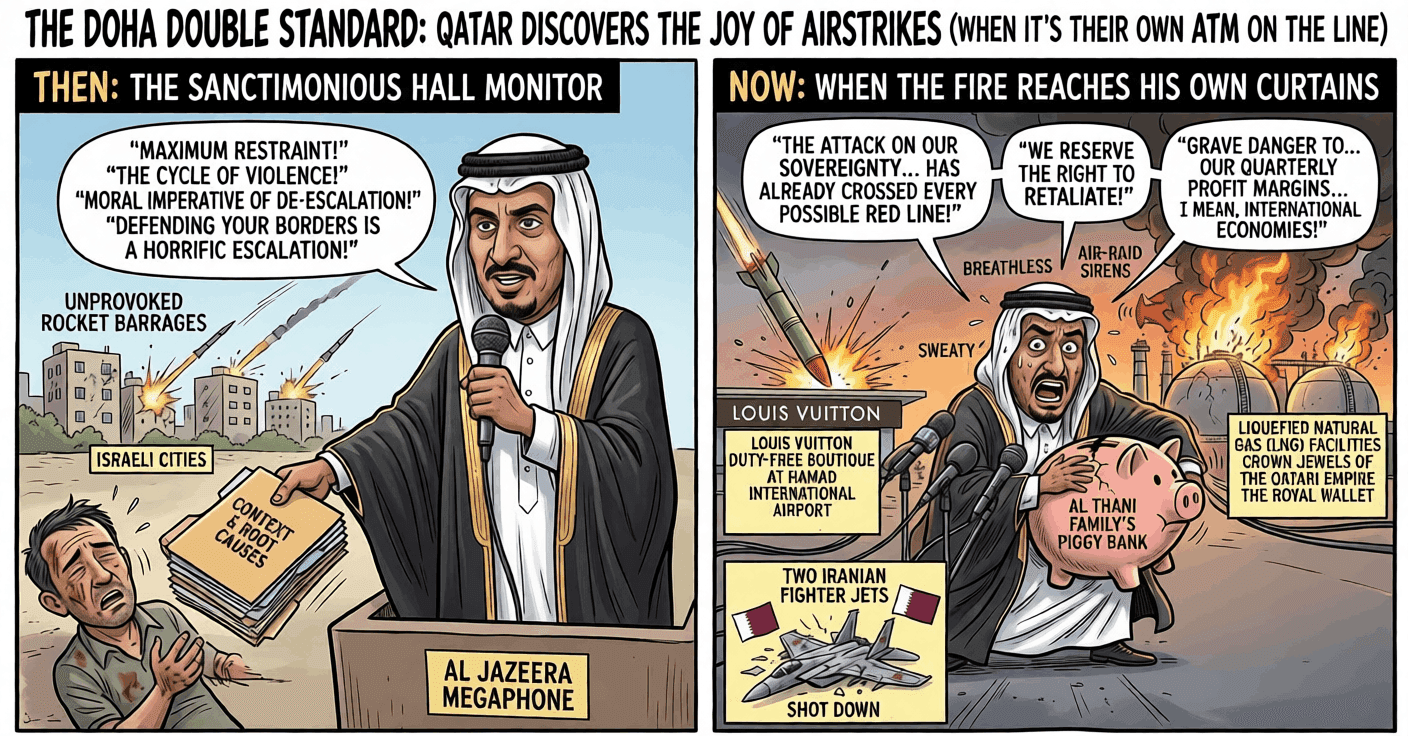
THE DOHA DOUBLE STANDARD: QATAR DISCOVERS THE JOY OF AIRSTRIKES (WHEN IT’S THEIR OWN ATM ON THE LINE)

Welcome back to the Geopolitical Theater of the Absurd, where the arsonist is suddenly crying to the UN because the fire finally reached his own curtains.

For the last two decades, the State of Qatar has been the sanctimonious hall monitor of the Middle East. Whenever Israel faced unprovoked rocket barrages, suicide bombings, or massacres orchestrated by Iranian-funded proxies, Doha was the first to grab the microphone. 

Through their state-run megaphone, Al Jazeera, they lectured the globe about “maximum restraint,” “the cycle of violence,” and the moral imperative of “de-escalation.”

Defending your own borders, according to the Qatari diplomatic playbook, was a horrific “escalation.”

But what happens when the Ayatollah decides to skip the proxies and fire directly at the Al Thani family’s piggy bank?

According to a breathless, sweaty press briefing from Qatari Foreign Ministry spokesperson Majed Al-Ansari this Tuesday, Iran just launched a massive strike on Qatari territory. We aren’t talking about a skirmish in an empty desert; Iran targeted Doha airport, civilian areas, and the absolute crown jewels of the Qatari empire: the Liquefied Natural Gas (LNG) facilities.

Suddenly, Doha’s diplomatic vocabulary has undergone a miraculous, hawkish transformation. It turns out “restraint” is for the peasants.

The Sudden Death of “Proportionality”

When Hamas fires thousands of rockets into Israeli cities, Qatar dispatches an envoy to talk about “context” and “root causes.”

But when an Iranian missile lands a little too close to the Louis Vuitton duty-free boutique at Hamad International Airport?

“The attack on our sovereignty... has already crossed every possible red line,” thundered Al-Ansari, suddenly sounding exactly like the Israeli Defense Ministers he has spent his entire career condemning. “We reserve the right to retaliate.”

Wait, what happened to sitting down at a mahogany table in Geneva to discuss the “nuance” of Iran’s grievances? What happened to the “cycle of violence”?

Apparently, “context” is only intellectually stimulating when the rockets are landing on Tel Aviv. When they threaten Qatar’s Wi-Fi, the gloves come off. Doha didn’t just write a sternly worded letter to the UN—they shot down two Iranian fighter jets that entered their airspace.

Where are the American university students pitching tents on the quad to protest Qatari aggression against Iranian pilots? Where are the UN resolutions demanding Doha lay down its arms and accept a ceasefire? Crickets

The “Grave Danger” to the Royal Wallet

The hypocrisy reaches absolute terminal velocity when Al-Ansari discusses the economic impact. Because Iran forced the temporary closure of Qatar’s LNG facilities, Doha is now frantically warning of a “grave danger to international economies.”

Let’s get this straight. For years, Qatar has funded, hosted, and shielded groups like the Houthis and Hamas, who have systematically disrupted global shipping in the Red Sea, paralyzed supply chains, and cost the global economy billions. Doha called that “resistance.”

But the second someone touches Qatar’s gas pipelines? The holy fountain of their sovereign wealth? It is an international crisis of apocalyptic proportions! Help us, the world economy is suffering! (Translation: Our quarterly profit margins are dipping, please send an American aircraft carrier).

The Irony of the 8,000 “Stranded” Passengers

Perhaps the most jaw-dropping moment of the briefing was Al-Ansari lamenting that Doha’s airspace is closed, leaving more than 8,000 transit passengers stranded and “hosted” inside the country.

While it is undeniably frustrating for those travelers, the irony of Qatar complaining about people being held against their will on their territory is almost too rich for human consumption.

Qatar has spent decades hosting the billionaire leadership of terror groups whose primary tactical innovation is taking actual, literal hostages. Doha is suddenly highly sensitive to the plight of people who just want to go home; unless, of course, you’re an Israeli toddler or an American citizen dragged into a tunnel, in which case Doha prefers to call you a “bargaining chip” while treating your captors to five-star room service at the Sheraton.

The “Resistance” Bites the Hand That Feeds It

Al-Ansari made it very clear: “Retaliation is firmly on the table... Qatar is able to stop any entity that is trying to attack.” He boasted about having “enough air-defense missiles to deal with any attack.”

It is a stunning, glorious pivot. The nation that practically invented the modern “Diplomacy of Delay” to protect terror groups from facing military consequences is now proudly rattling its own sabers.

Qatar played a highly lucrative, highly dangerous game for twenty years. They believed they could fund the extremists, host the clerics, and incite the entire region via Al Jazeera, all while remaining perfectly immune inside their glass towers because they let the US park some jets at Al Udeid. They truly believed they were the untouchable puppet masters.

But as the air-raid sirens wail over the LNG facilities, Doha has learned a brutal, unavoidable lesson: To the Islamic Republic of Iran, you aren’t a trusted ally. You are just a remarkably wealthy target with a glass jaw.

Welcome to the real Middle East, Qatar. We hear the “cycle of violence” is lovely this time of year.

That’s Qatarted!

Mar 4, 2026

4 min read

The Durand Line Thunderdome: How Doha is Brokering the Pakistan-Taliban Divorce (While Cashing the Divorce Lawyer Fees)

Welcome back to the Geopolitical Theater of the Absurd, folks, where the leopards aren’t just eating faces, they’re doing a full buffet on the idiots who spent decades breeding, arming, and cosplaying them as “strategic assets.” The referee? A gas-rich micro-state in flowing robes, clocking overtime in its five-star conference rooms while the region goes full Mad Max.

As of late February 2026, Afghanistan and Pakistan didn’t just cross the Durand Line, they nuked the concept of it. Pakistan is raining hellfire on Kabul and Kandahar. The Taliban have mobilized their shiny new 172,000-strong conventional army (yes, the same guys who used to brag about riding around in Hiluxes) and are storming Pakistani border posts like it’s Black Friday at the jihad store. And who swoops in like a white-robed angel of mercy? Qatar. The same Qatar that spent years babysitting these clowns in Doha luxury hotels until they could seize a whole country.

At That’s Qatarted!, we’ve been tracking this slow-motion train wreck since the Taliban victory lap in 2021. Grab your popcorn, your kevlar, and maybe a stiff drink — because the Af-Pak “stabilization” fairy tale just face-planted into a full-scale conventional war, and Doha is already selling overpriced band-aids with a side of diplomatic prestige.

Frankenstein’s “Righteous Fury,” Now With Extra Irony

On February 21, 2026, the Pakistan Air Force kicked off “Operation Ghazab Lil Haq” (Righteous Fury, because nothing says righteous like bombing the monster you spent 20 years building in your basement). Pakistani generals are crying that TTP and ISIS-K are using Afghan soil as a launchpad for attacks on Islamabad and Bajaur.

The irony is so radioactive it could power Karachi for a decade. Islamabad literally midwifed the Afghan Taliban as “strategic depth” against India. They clapped like seals when Kabul fell in 2021. Now their own geopolitical Frankenstein is letting anti-Pakistan jihadis run wild -  and Islamabad’s response is to bomb the lab. Classic “we created the problem and now we’re shocked the problem is problematic.”

The “Westphalian” Warlords – Because Nothing Says Modern State Like Suicide Brigades

The Taliban’s retaliation? Pure comedy gold. These guys,  who spent two decades screaming that borders are un-Islamic colonial inventions, are now clutching their pearls over “Westphalian sovereignty” like they just graduated from the Sorbonne with a minor in 17th-century European treaties.

Gone are the days of ragtag insurgents. They’ve got the Badri 313 Battalion, an official “Suicide Squad” on standby, and a 172,000-man army ready to throw bodies at a nuclear-armed neighbor. Their battle plan: “How dare you violate our sacred airspace! Quick, deploy the suicide brigade!” Somewhere in hell, Mullah Omar is face-palming so hard his turban spins.

The Doha Mediation Franchise: The Pyromaniac Firefighter

And right on schedule, here comes Qatar — the self-appointed “neutral intermediary” — offering to mediate the very dumpster fire they spent a decade pouring gasoline on.

This is the Qatari business model in its purest, most shameless form:

1. Host the Taliban political office for years, give them diplomatic cover, five-star rooms, and endless photo-ops.

2. Watch them take over Afghanistan and immediately start exporting chaos to their neighbors.

3. Swoop in as the “only credible broker” because, surprise, nobody else wants to talk to these guys.

Qatar isn’t a mediator. It’s a geopolitical chiropractor who breaks your spine at night and then charges you triple for the adjustment. Pyromaniac Firefighter LLC — now franchised in Geneva and Kabul!

Mediation Bandwidth Overload: Doha’s Diplomatic Uber Eats App Is Crashing

Here’s the best part: Qatari diplomats are apparently suffering from “mediation bandwidth issues.” While Pakistan and the Taliban are trading airstrikes and suicide attacks, Doha is also trying to juggle the US-Iran nuclear talks that are currently sitting on a 50-50 knife-edge to regional apocalypse.

Imagine the scene in the Doha war room: Ayatollahs on Line 1 threatening Armageddon, Pentagon on Line 2, Taliban on Line 3 screaming about “Westphalian violations,” and Pakistan’s generals on hold listening to smooth jazz. The entire stability of Eurasia now depends on whether some Qatari envoy’s iPhone battery lasts long enough to keep three apocalyptic fires from merging into one giant blaze.

The Political Cost of Peace (Spoiler: It’s Expensive)

Neither side can back down without looking weak. Pakistan’s Defence Minister is out here declaring “open war.” PM Shehbaz Sharif is vowing to “crush the aggressors.” You can’t bomb two major Afghan cities and then tweet “lol jk, let’s hug it out.”

Enter Qatar with its premium product: Face-Saving as a Service (FSaaS)™. They’ll broker some meaningless photo-op deal where Pakistan claims it “eradicated the TTP threat,” the Taliban claims it “heroically defended sacred borders,” and everyone goes home pretending nothing happened. The TTP will just move to a nicer cave, Pakistan will buy more jets, the Taliban will keep expanding its suicide economy, and Qatar will collect another participation trophy for “peace.”

The UN, India, and anyone with a functioning brain are begging for “maximum restraint.” Cute. Restraint doesn’t win elections or distract starving populations from the fact that both countries are spectacularly failing at governance.

This isn’t counter-insurgency anymore. It’s Thunderdome: two dysfunctional states enter, one diplomatic grift leaves.

And chilling in an air-conditioned Doha suite, counting the prestige points and future mediation contracts, is the one entity that benefits from this bleeding never stopping: Qatar. They don’t want to solve the Afghanistan-Pakistan conflict. Solved conflicts don’t need middlemen.

That’s Qatarted!

Mar 1, 2026

5 min read

The Qatari Gambit: Or How Doha Bought the CIA for a Soccer Game (and Kept the Spies on Payroll)

Welcome back to the Geopolitical Theater of the Absurd, where foreign policy is auctioned off like a distressed asset on eBay and American national security comes with a convenient “buy now, pay in oil” button.

If you thought the 2022 FIFA World Cup was just about shiny air-conditioned stadiums, migrant workers treated like disposable props, and suitcases of cash vanishing into FIFA’s offshore vaults, you were only licking the frosting. The real main course? The full privatization of U.S. intelligence—sold, shipped, and gift-wrapped straight to Doha.

At That’s Qatarted!, we’ve dug through the receipts on the “Qatari Gambit.” Turns out Qatar didn’t waste time building its own spy agency. Nah. They just ordered takeout from Langley. Why grow your own when America’s finest alumni are one generous consulting fee away from becoming your personal shadow government?

The “Rent-a-Spy” Architecture (Now With Gulf Royalties)

Enter Kevin Chalker, former CIA undercover ops officer who realized pensions are cute, but Qatari generational wealth is forever. Codename? “Hercules.” Because nothing screams subtle like a Greek god cosplaying as a Gulf errand boy.

His outfit, Global Risk Advisors (GRA), set up shop in New York, London, and Doha like the world’s most expensive spy Uber. The pitch deck? A casual $60 million letter of intent for “intelligence collection, predictive analysis, and information operations.” Even spicier: one of the key consultants pitching this was still a current CIA employee moonlighting as Silicon Valley’s liaison. Conflict of interest? Honey, that’s just called “networking” when the checks clear in riyals.

Project MERCILESS: Because Spying on Soccer Should Cost More Than Most Countries’ GDPs

When Qatar spies, it doesn’t do “budget.” Project MERCILESS came with a proposed $387 million price tag over nine years—just to own international soccer from the inside out.

The crown jewel? Project Matterhorn—where GRA allegedly bugged a 2017 sit-down between FIFA boss Gianni Infantino and Swiss Attorney General Michael Lauber. Location? A Qatari-owned luxury hotel in Bern that also housed the Qatari embassy. Brilliant. Invite the investigators to your own bugged suite, serve them sparkling water, and record every damning word. It’s not espionage—it’s hospitality with benefits. That’s Qatarted!

The Varsity Blues of Espionage (Participation Trophies Included)

GRA didn’t stop at surveillance. They ran “Mini-Farm” boot camps (straight rip-offs of the CIA’s legendary Camp Peary) teaching Qataris paramilitary tactics, encryption, and tradecraft. 

But this is Qatar, where royal blood beats actual effort. Internal docs show a member of the Al Thani family scored a perfect 100% in Technical Surveillance Countermeasures… despite skipping most classes and showing all the enthusiasm of a cat at a bath. Congratulations, Your Highness! Here’s your diploma. Try not to wiretap your own yacht by accident.

Project Soccer Spy: Honeypots, Pickaxes, and Zero Shame

The 2022 World Cup was Qatar’s live-fire exercise. To crush rival bids from the U.S. and Australia, GRA went full state-on-state dirty tricks on civilians:

- Fake photojournalist operatives stalking delegations.  

- Facebook honeypots—hot fake profiles luring middle-aged soccer suits into handing over their phones.  

- Project Pickaxe—a proposal to hoover up biometrics and personal data on every migrant slave building those stadiums. Because nothing screams “World Cup values” like CIA-grade tracking of indentured labor.

It worked so well they decided to bring the toys home… straight to Capitol Hill.

Project ENDGAME: Defending Hamas from the Senate Floor

Fresh off the soccer victory lap, Qatar pivoted to protecting its favorite ideological investments. Project ENDGAME’s internal manifesto was crystal clear: “An attack on Hamas is an attack on Qatar. An attack on the Muslim Brotherhood is an attack on Qatar.”

Let that marinate. Former U.S. intelligence officers—paid millions by Doha—were allegedly running interference for Hamas inside the U.S. Congress.

When Senators Ted Cruz, Tom Cotton, and Rep. Mario Diaz-Balart tried to designate the Muslim Brotherhood a terrorist group? GRA didn’t hire lobbyists. They deployed “Access Agents” inside the lawmakers’ inner circles to whisper, leak, and neuter the bills. They even ran a full hack-and-leak on Trump fundraiser Elliott Broidy—stealing his emails, dumping them to the press, and trying to frame him in the Mueller probe. Classic. Steal the data, weaponize the media, pocket the check.

The Trojan Horse App (Your World Cup Selfie Is Now State Property)

Not content with human spies, GRA pitched Project Berlin, a total surveillance wet dream. The official 2022 World Cup app was supposed to be the ultimate Trojan horse: tracking every fan’s movements, contacts, locations, and live conversations via “Real-Time Conversation Isolation.” 

Download the app to watch Messi? Congrats, your phone just became a walking Qatari microphone. Hope the selfies were worth it.

The “Intangible” Loophole and the Quantum Grift

The FBI is now crawling all over Chalker and GRA for foreign agent violations and exporting sensitive tech. But here’s the hilarious loophole: America guards tangible weapons like Tomahawk missiles. “Intangible” tradecraft—brains, methods, psychological ops? Wide open for export. Qatar just bought the CIA’s operating manual and called it “consulting.”

And the punchline that writes itself? After the contracts dried up and the FBI started sniffing around, Chalker simply rebranded as CEO of Qrypt—a quantum cybersecurity firm selling “unbreakable encryption.” 

Because sure, the guy under federal scrutiny for allegedly hacking Americans on behalf of a Hamas-friendly monarchy is exactly who you want guarding the future of digital security. What could possibly go wrong?

The tradecraft we funded with taxpayer dollars to protect America was auctioned off to the highest bidder with a gas pipeline. Energy-rich regimes don’t need to beat us. They just hire our retirees.

Marhaba to the privatized intelligence economy.

That’s Qatarted!

Mar 1, 2026

5 min read

The Qatar Qurriculum: How Doha Domesticates Hate at Home

Welcome back to the Geopolitical Theater of the Absurd, where the concession stand sells both gluten-free, fair-trade vegan cookies and handbooks on how to dismantle Western civilization.

If you have been paying attention to the global education sector, you might have noticed a fascinating phenomenon. The State of Qatar has become the Sugar Daddy of American Higher Education. Billions of dollars flow from the gas fields of the Gulf into the endowments of America’s most prestigious universities.

In these hallowed Western halls, Qatari money funds departments dedicated to “decolonization,” “critical theory,” and the dismantling of “imperialist power structures.” They are paying for American students to learn that the West is bad, that power is oppression, and that “micro-aggressions” are a form of violence.

But back in Doha? Oh, the syllabus looks a little different …

At That’s Qatarted!, we have cracked open the books, specifically the 2025–2026 Qatari National Curriculum, and discovered the most expensive case of Pedagogical Schizophrenia in history.

While Qatar pays American professors to teach that “words are violence,” they are simultaneously teaching their own children that actual violence is a spiritual promotion.

The Great Export: Sovereign Woke Wealth

Let’s start with the export product. Qatar knows its market. They know that the most valuable commodity in the West right now is Guilt.

So, they buy it. They pour money into American universities to ensure that the next generation of Western leaders is paralyzed by self-loathing. It is a brilliant strategy: The “Soft Power” Suicide Vest. You don’t need to fight the West if you can just pay the West to hate itself.

In the US, Qatari-funded programs will lecture you on the importance of “inclusive language” and “safe spaces.” They will tell you that the American flag is a symbol of aggression and that borders are a social construct.

But fly 7,000 miles to Doha, walk into a 7th-grade classroom, and the “Social Construct” looks a lot like a fortress.

The Domestic Reality: Curricular Cryogenics

According to the latest analysis of the 2025–2026 curriculum, Qatar has entered a state of “Curricular Stasis.” This is a polite way of saying they have frozen their textbooks in time—specifically, a time somewhere between the 12th century and 1948. Despite years of promises to the West, despite the “Major Non-NATO Ally” badge pinned to their chest by the Pentagon, the Qatari textbooks haven’t changed.

The “Reform” button is broken. The “Update” feature is disabled.

While American students in Qatari-funded dorms are being taught that “silence is violence,” Qatari students are being taught that Jihad is the peak of Islam. And we aren’t talking about the “internal spiritual struggle” kind of Jihad. The textbooks are quite specific. They are talking about the “sacrifice of life” kind.

The curriculum eulogizes martyrdom. It frames violent conflict not as a tragedy, but as a career goal. It creates a “Warrior Scholar” model where the ultimate extracurricular activity isn’t the Debate Team; it’s the Militia.

The “Traits of the Jews” (No, Seriously)

In the US, a university funded by Qatar might launch an investigation if a student wears a sombrero on Halloween, citing “cultural insensitivity.”

Meanwhile, in Doha, the 2025–2026 curriculum continues to feature content that would make a 1930s European propagandist blush. The analysis highlights a persistent obsession with “The Traits of the Jews.”

Spoiler alert: They aren’t listing “high literacy rates” or “Nobel Prize winners.”

The textbooks describe Jewish people as “treacherous,” “deceitful,” and “hostile.” This isn’t subtle dog-whistling; this is a bullhorn. The curriculum explicitly frames the Jewish people not as neighbors or a religious group, but as an existential enemy to Islam and the Arab world.

And the best part? The extracurriculars match the coursework. The report notes a student exhibition titled “The Traits of the Jews” which mirrored the antisemitic tropes found in the books. Imagine the scene: A science fair, but instead of baking soda volcanoes, you have dioramas of hate speech.

This is the Doha Dissonance.

  • In New York: Qatar funds a seminar on “Combating Islamophobia and Structural Racism.”

  • In Doha: Qatar funds a textbook that says, “Don’t trust the Jews, they are plotting against you.”

The “Major Non-NATO” Joke

Here is where the satire writes itself.

Qatar is designated as a “Major Non-NATO Ally” of the United States. This status is supposed to be reserved for countries that share strategic interests and values with the US.

The US military has a massive base in Qatar (Al Udeid). American soldiers are literally guarding the airspace of a country that is teaching its children that Western influence is a “cultural invasion.”

The 2025–2026 curriculum frames Western history and policy as inherently hostile to Islam. It teaches students to view the US not as a partner, but as an imperialist aggressor trying to dismantle their religion.

So, let’s get this straight:

  1. The US protects Qatar.

  2. Qatar pays US universities to teach American kids that the US is evil.

  3. Qatar teaches Qatari kids that the US is evil.

  4. The US State Department issues a polite report saying, “Please fix this,” and Qatar leaves the message on ‘Read’ for four years.

It is the ultimate Geopolitical Cuckoldry. The US is paying for the dinner, driving the car, and holding the door open, while Qatar spends the entire date texting the Muslim Brotherhood about how much they hate the driver.

The “Context” Scam

Whenever Western journalists ask about this, Qatari officials will pivot to “Context.” They will talk about “cultural nuances” and “sovereign values.”

They use the language of the Left—which they learned from the very universities they funded—to defend the policies of the Far Right.

  • “We are resisting cultural imperialism!” (Translation: We want to teach antisemitism).

  • “We are centering our indigenous narrative!” (Translation: We want to glorify terrorists).

They have weaponized the Western academic vocabulary against the West. They know that if they scream “Islamophobia” loud enough, the American dean of the satellite campus will apologize and back down.

The “Zombie” Network

The report warns of “zombie crony networks” and the glorification of leaders designated as terrorists by the West.

In the US, if a professor retweets a controversial article, they might lose tenure. In Qatar, the official responsible for national pedagogy can publicly align with leaders of groups the US calls terrorists, and the textbooks just get a reprint.

The curriculum uses euphemisms like “military operations” to describe terrorist attacks against civilians. It sanitizes violence. It turns mass murder into a tactical flowchart.

This isn’t an oversight. It isn’t a “legacy issue” they forgot to delete. It is the Point.

Qatar is building a generation of “Janus-faced” elites.

They will speak perfect English. They will have degrees from Georgetown or Northwestern in Qatar. They will know the correct pronouns to use in a Brussels boardroom.

But underneath the crimson graduation gown, the operating system is running on Anti-Western 2.0.

The Investment Strategy

Why does Qatar do this? Why play both sides?

Because it works.

They have realized that the West is for transaction, but the East is for identity.

They buy the West’s technology, its weapons, and its university brands. They use the West to secure their borders and diversify their economy.

But they do not want the West’s values.

They want the prestige of Harvard without the liberalism. They want the protection of the US Air Force without the secularism.

And so far, the West has been happy to take the check and look the other way.

American university presidents fly to Doha, sit in air-conditioned majlises, and nod politely while their hosts discuss “educational cooperation.” They don’t ask what’s in the Arabic textbooks in the public schools down the street. They don’t want to know.

Checking the translation might endanger the endowment.

The Qatarted Pricing Model

So, the next time you see a student protest at a US university, waving a flag and chanting slogans that sound suspiciously like they were translated from a Qatari press release, remember where the funding comes from.

And the next time you hear a Qatari diplomat talk about “tolerance” and “interfaith dialogue” at the UN, remember what his nephew is reading in 4th period History class.

Qatar has mastered the art of the split-screen existence.

On Screen 1 (The West): Diversity, Equity, Inclusion, Green Energy, Soccer.

On Screen 2 (Domestic): Jihad, Anti-Zionism, Anti-Westernism, Martyrdom.

They are betting that we are too greedy to look at Screen 2, and too stupid to realize that Screen 1 is just a screensaver.

That’s Qatarted!

Feb 16, 2026

7 min read

The Pills and The Playbook: How Doha is Curing Sudan (and Prescribing a Little Ideology on the Side)

Welcome back to the Humanitarian Hunger Games, where the only thing more abundant than the suffering is the press releases about who is “saving” the victims.

If you have been following the tragic civil war in Sudan—a conflict that has turned Khartoum into a shooting gallery and displaced millions—you might be relieved to hear that help is on the way. And not just any help. Qatari Help.

According to a breathless press release issued on February 8, 2026, the Qatar Fund for Development (QFFD) and the Qatar Red Crescent Society (QRCS) have launched an “overland land bridge” to deliver life-saving medicines to the “brotherly Republic of Sudan.”

It sounds beautiful, doesn’t it? Seven trucks rolling across the border, laden with pharmaceuticals, hope, and the unconditional love of the Emir.

But at That’s Qatarted!, we have a golden rule: When Doha sends a bandage, check for the strings attached. Because in the world of Qatari foreign policy, humanitarian aid is never just aid. It is a Trojan Horse with a Red Crescent painted on the side.

The “Brotherly” Embrace (with a Knife in the Back)

Let’s start with the language. The press release refers to the “brotherly Sudanese people” about five times. It’s very touching.

But do you know who else Qatar considers a “brother”?

General Abdel Fattah al-Burhan, the military leader who has been busy bombing his own capital. And let’s not forget their historical bromance with the Rapid Support Forces (RSF), the militia currently accused of ethnic cleansing in Darfur.

Qatar spent years playing both sides of the Sudanese conflict, hosting peace talks in Doha that went nowhere while allegedly funneling support to Islamist factions that helped destabilize the country in the first place.

Now, they are rushing in with medicine to treat the wounds caused by a war they helped incubate. It’s like an arsonist showing up to the fire with a bottle of water and expecting a medal for bravery.

The “Systematic” Delivery of Ideology

The press release proudly states that the aid will benefit “at least half a million people across 12 different Sudanese states.”

This is the Distribution Strategy.

By controlling the flow of life-saving medicine, Qatar isn’t just saving lives; they are building Client Networks.

When a desperate mother in Port Sudan receives antibiotics for her child, she doesn’t see a “soft power strategy.” She sees a Qatari flag on the box.

This is how you buy loyalty in a failed state. You don’t need to win an election; you just need to be the guy with the insulin.

And who manages this distribution on the ground? The Qatar Red Crescent Society, an organization that, while doing genuine relief work, also serves as a convenient vehicle for Doha to access “conflict zones” where other NGOs fear to tread.

It gives them eyes, ears, and influence in the most sensitive parts of the country.

The 13.3 Million Riyal “Investment”

The total cost of this aid package is listed as QAR 13.3 million (approx. $3.6 million USD).

To you and me, that’s a lot of money.

To Qatar, a nation that spent $220 billion on a soccer tournament, it is a rounding error. It is the cost of a backup striker for PSG.

But the Return on Investment (ROI) is massive.

For the low, low price of $3.6 million, Qatar gets:

  1. Moral High Ground: “Look at us, saving the Muslims while the West does nothing!”

  2. Diplomatic Leverage: “We are essential to the stability of Sudan; you must talk to us.”

  3. Ideological Access: A direct line to the local communities, bypassing the central government, to plant the seeds of their preferred brand of political Islam.

It is Venture Capital Philanthropy. They are buying equity in the future of Sudan for pennies on the dollar.

The “Noble Initiative” Myth

The Assistant Secretary-General of QRCS calls this a “noble initiative.”

Let’s be real. There is nothing “noble” about using starving, sick people as props in a geopolitical influence campaign.

If Qatar really cared about the “brotherly Sudanese people,” they would use their immense leverage to force the warring generals—many of whom have bank accounts in the Gulf—to stop shooting.

But peace is bad for business. Peace means you can’t be the savior. Perpetual conflict with a steady drip of “humanitarian aid” is the sweet spot. It keeps the population dependent and the warlords manageable.

The Islamist Pricing Model

So, as the seven trucks rumble towards Khartoum, remember this:

They are not just carrying medicine. They are carrying the Doha Operating System.

The pills will cure the infection, but the prescription comes with a side effect: a long-term dependency on a state that views Sudan not as a neighbor, but as a project.

That’s Qatarted!

Feb 10, 2026

4 min read

The Gaslighting of the Gulf: Qatar Discovers Pacifism (The Second Their Pipelines Catch Fire)

Welcome back to the Geopolitical Theater of the Absurd, where the rules of international conflict are written in pencil, heavily redacted by lobbyists, and completely inverted the absolute second the State of Qatar feels a slight breeze against its bank account.

If you want to witness the greatest vanishing act in the history of modern diplomacy, you do not need to travel to Las Vegas to see David Copperfield. You only need to look at the sudden, miraculous disappearance of Qatar’s appetite for “holy resistance.”

For decades, the Qatari ruling elite has operated as the world’s most well-funded arsonists. They have poured billions of dollars into the ideological and military infrastructure of radical Islamist groups across the Middle East. They built the stadium, they funded the teams, they paid the referees, and they broadcast the matches live on Al Jazeera. They reveled in the chaos. But this week, a profound and terrifying reality finally breached the mahogany-lined walls of the Emiri Diwan in Doha: the war they helped start has finally reached the Persian Gulf energy sector.

And suddenly, the arsonists are frantically dialing 911, screaming that the fire is an existential threat to humanity.

Following recent kinetic strikes against critical Gulf energy infrastructure, the Qatari Prime Minister rushed to the microphones with a newfound, breathless sense of apocalyptic urgency. The message was no longer about “context.” It was no longer about “nuance.” It was no longer about “the legitimate grievances of the resistance.”

The new message, delivered with the panicked sweat of a man whose luxury yacht is taking on water, was simple: “This war must be stopped immediately.”

Not tomorrow. Not after a negotiated settlement in Geneva. Immediately. We at That’s Qatarted! are connoisseurs of hypocrisy. We study it, we document it, and we marvel at its boundless depths. But the absolute, unmitigated gall required for the State of Qatar to suddenly play the role of the frantic peacemaker—only after their own regional ATM is threatened—is a masterpiece that belongs in the Louvre of gaslighting. Let us take a deep, comprehensive dive into the anatomy of this spectacular double standard.

The Epiphany of the ATM

To truly understand the comedy of the Qatari Prime Minister’s sudden panic, we must contrast it with Doha’s behavior over the last several years.

When Hamas - a terror syndicate wholly subsidized, sheltered, and politically directed by Qatar - launched an unprecedented campaign of mass slaughter, rape, and kidnapping against Israeli civilians, did the Qatari Prime Minister rush to a podium and demand that the violence be “stopped immediately”?

Absolutely not.

When Jewish civilians were being pulled from their beds, the Qatari diplomatic machine shifted into its patented “Diplomacy of Delay” gear. They released sterilized, victim-blaming statements urging “all parties to exercise maximum restraint.” They dispatched their impeccably tailored envoys to Western capitals to lecture the world about the “root causes” of the violence. They argued, with a straight face, that Israel’s military response was an “unacceptable escalation” that ignored the historical context of the region.

To the Qatari elite, the shedding of Israeli blood was not an emergency. It was leverage. It was an opportunity to position themselves as the “indispensable mediators,” extorting diplomatic concessions from the United States while their billionaire Hamas guests ordered room service at the Sheraton in Doha.

But what happens when the theater of war shifts? What happens when the missiles and drones are no longer falling on Sderot or Tel Aviv, but are suddenly striking the vital energy arteries of the Persian Gulf?

The “root causes” vanish into the desert air.

The moment a kinetic strike hits a regional oil refinery or an LNG terminal, the Qatari leadership suffers a catastrophic allergic reaction to their own geopolitical philosophy. When the violence threatens the Qatari bottom line, there is no more talk of “context.” There is only an hysterical, pearl-clutching demand that the international community intervene to protect the sacred infrastructure of the Gulf monarchies.

They are the ultimate fair-weather fanatics. They love the jihad when it is happening in someone else’s backyard. But the second the “axis of resistance” threatens the supply chains that fund their Louis Vuitton boutiques and their Ivy League endowment bribes, they suddenly sound like a coalition of Quaker pacifists.

Houthi Hypocrisy

The hypocrisy becomes even more grotesque when we examine Qatar’s recent posture regarding global shipping and international trade.

For the better part of two years, the Iranian-backed Houthi militia in Yemen has been systematically terrorizing the Red Sea. They have fired anti-ship ballistic missiles at civilian freighters, kidnapped international sailors, and forced the world’s largest shipping conglomerates to reroute their vessels thousands of miles around the Horn of Africa. This campaign of maritime terrorism has choked global supply chains, driving up inflation and hurting the poorest nations on Earth.

And what was Qatar’s official stance on this crippling of the global economy?

Through their state-run media apparatus and their diplomatic proxies, Qatar essentially acted as the Houthis’ defense attorney. They continually pushed the narrative that the Houthi blockade was a “natural consequence” of the war in Gaza. They warned the United States and the United Kingdom against striking Houthi launch sites, claiming that military action would only “widen the conflict.”

Qatar was perfectly content to watch the global economy suffer, because the disruption applied political pressure on the West to force Israel into a premature ceasefire. They treated the Red Sea crisis as a useful geopolitical tool.

But today, the script has been violently flipped. The attacks are no longer confined to the Bab-el-Mandeb strait. They have reached the Gulf energy sector. And suddenly, the Qatari Prime Minister is warning the world of the catastrophic, unthinkable economic consequences of allowing this war to continue for even one more day.

“This war must be stopped immediately!” he cries, implicitly begging the American and European navies to rush to the defense of the Gulf.

When the Houthis choked European trade to defend Hamas, Qatar called it “context.” When attacks hit Gulf energy facilities and threaten Qatari revenue, Qatar calls it an international emergency requiring immediate Western intervention. It is the Geopolitical Munchausen Syndrome in its purest form: they create the disease, sponsor the pathogens, and then scream for the doctors the moment they catch a mild fever.

The Al-Jazeera Disconnect

No analysis of Qatari statecraft is complete without examining their primary weapon of mass deception: Al Jazeera.

If you want to measure the sheer schizophrenia of the Qatari state, you only need to put a television screen broadcasting Al Jazeera Arabic next to a screen showing the Qatari Prime Minister speaking to Western diplomats.

On Al Jazeera Arabic, the war is an unending, glorious holy struggle. The network pumps highly addictive ideological narcotics directly into the veins of the Arab street 24 hours a day. It glorifies “martyrs,” it praises the “resistance,” and it continuously incites the masses to rise up against the West and its regional allies. It is a multi-billion-dollar psychological operations apparatus designed to ensure that the Middle East remains radicalized, angry, and permanently boiling.

Yet, while his state-funded television network is actively cheerleading for the destruction of the Western world order, the Qatari Prime Minister puts on a bespoke suit, stares into the camera of a European news agency, and begs the West to stop the war to protect global energy markets.

He wants the United States to protect the very infrastructure that funds the television network that tells the Arab world to hate the United States.

It is a grift of such staggering proportions that one almost has to admire the sheer sociopathy of it. They are selling the matches, pouring the gasoline, broadcasting the fire, and then charging the fire department a premium to use their fire hydrant.

Holding the World Hostage – Again

Why is the Qatari Prime Minister issuing these desperate demands now? It is not because he has suddenly discovered a deep, abiding love for human life or regional stability. It is because he is deploying the final, most cynical tool in the Qatari playbook: The Energy Hostage Strategy.

Qatar knows that the Western political elite, particularly in Europe, are uniquely vulnerable to energy shocks. European politicians are terrified of inflation, terrified of winter heating bills, and terrified of their own voters.

By running to the press and loudly declaring that the war “must be stopped immediately” due to attacks on Gulf energy, Qatar is purposefully inducing panic in the Western markets. They are signaling to Brussels, London, and Washington: If you do not force Israel to stop dismantling our Islamist allies in the region, your gas prices are going to skyrocket, your economies will crash, and your political careers will be over. They are weaponizing the vulnerability of the global energy supply chain to save the “Axis of Resistance” from total defeat.

Qatar realizes that their primary regional ally - the Islamic Republic of Iran - is currently taking a historic beating. The proxy network that Tehran and Doha spent decades building is being systematically dismantled. Hamas is in ruins. Hezbollah’s leadership is decimated. And now, the kinetic strikes are inching closer and closer to the very energy infrastructure that keeps the Gulf monarchs in power.

The Qatari Prime Minister’s plea is not a call for peace. It is a desperate SOS to the West to save the Islamist political project before it is entirely uprooted. He is using the threat of an energy crisis to blackmail the free world into saving the radical world.

The Cowardice of the Middleman

In the tribal, unforgiving culture of the real Middle East, respect is earned through strength, honor, and a willingness to stand behind your actions.

Qatar has none of these things. They are a nation of middlemen. They thought they had achieved the ultimate geopolitical hack: they believed they could fund the most violent, disruptive forces on the planet, completely insulate themselves from the consequences, and then charge a “mediation fee” when the violence inevitably spilled over.

They truly believed that their endless wealth, their Ivy League university endowments, and their slick public relations campaigns made them untouchable. They thought they could domesticate the monsters of the Middle East.

But the monsters are off the leash. The war has escaped the neat, controllable boundaries that Qatar envisioned. The violence is no longer safely contained to the Levant; it is threatening the very pipelines and export terminals that give Qatar its power.

And the absolute second the reality of this war breached their comfort zone, the Qatari facade crumbled. The tough-talking sponsors of “resistance” immediately ran behind the skirt of the international community, begging the Americans to stop the fighting.

They are the neighborhood bully who throws rocks at windows from behind a fence, only to call the police the moment someone walks through their front gate.

The international community must not fall for this desperate, pathetic ploy. For too long, the West has allowed Qatar to play both sides of the table, turning a blind eye to their financing of terror in exchange for natural gas and empty diplomatic promises.

If Qatar’s energy infrastructure is threatened, it is a consequence of the very regional instability they have spent decades cultivating. You cannot feed the crocodile for twenty years and then complain to the United Nations when it finally decides to snap at your own leg.

The war will stop when the forces of radical Islamism - the very forces Qatar has nurtured and protected - are defeated. Until then, the Qatari Prime Minister can sweat in his mahogany office and contemplate the terrifying reality that in the Middle East, you eventually reap exactly what you sow.

That’s Qatarted!
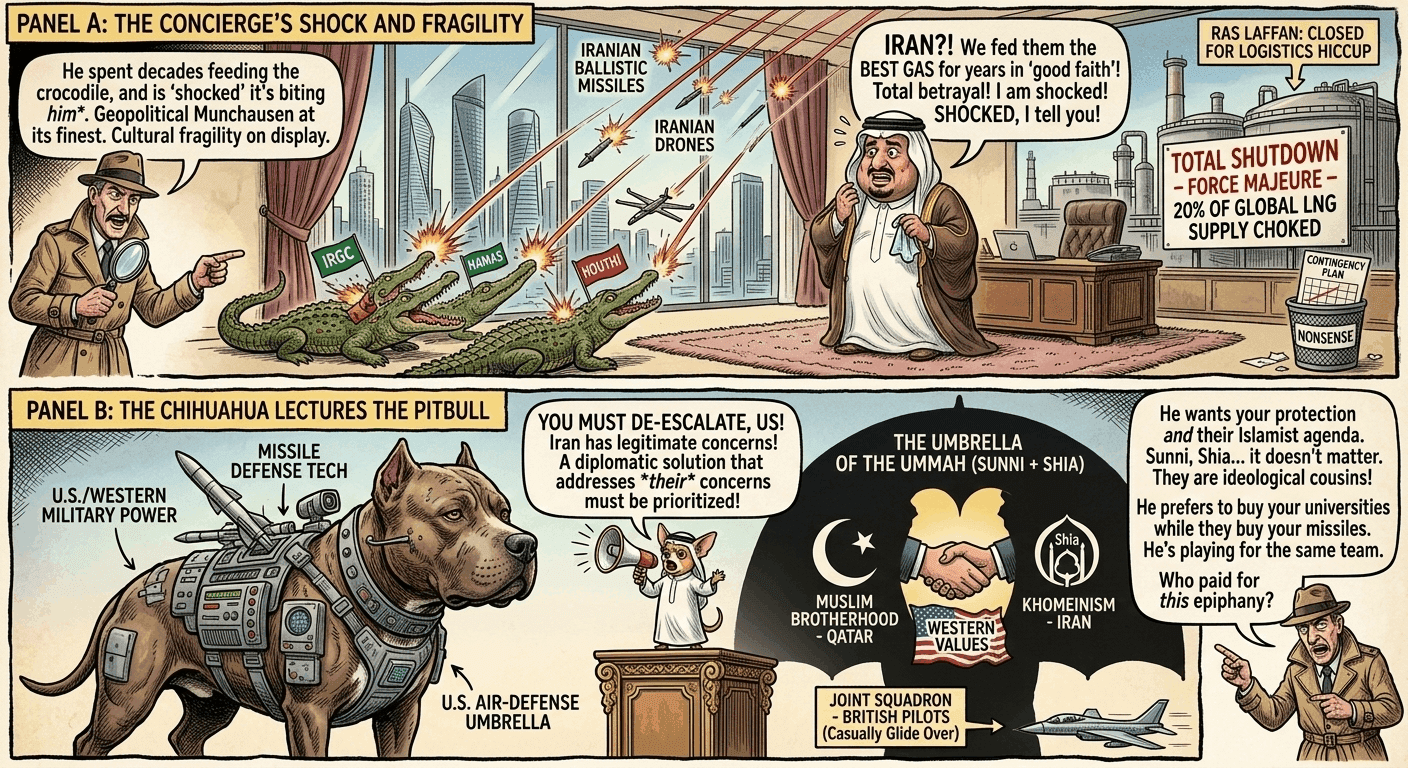
THE CARTEL OF CHAOS: QATAR LECTURES THE WORLD ON DRUGS WHILE SMUGGLING IDEOLOGICAL NARCOTICS

Welcome back to the Geopolitical Theater of the Absurd, where the world’s most prolific sponsors of ideological radicalism put on bespoke Italian suits, fly private jets to European capitals, and lecture the rest of us on moral purity.

If you want to witness a masterclass in parasitic statecraft, absolute cognitive dissonance, and the kind of staggering hypocrisy that could bend the laws of physics, look no further than the latest dispatch from the state-run Qatar Tribune.

The headline reads like an Onion article that accidentally made it to the printing press: “Qatar affirms commitment to boosting intl cooperation against world’s drug problem.”

Yes, you read that correctly. The State of Qatar—the geopolitical sugar daddy of the Muslim Brotherhood, the luxury concierge for Hamas, and the diplomatic shield for the Taliban—recently stood before the international community to express its deep, unwavering, and profound concern about... narcotics.

According to the official state propaganda, Qatari diplomats recently took to the podium at a global forum to boast about their “comprehensive and multidisciplinary approach” to fighting the global drug trade. They pontificated about the necessity of “shared responsibility,” the importance of “border security,” and their noble dedication to protecting the youth from the ravages of addiction.

Qatar pretending to care about the global drug problem is the geopolitical equivalent of Al Capone lecturing the local PTA on the dangers of jaywalking. It is a spectacular, breathtaking grift. And we at That’s Qatarted! are here to dissect exactly how the Primadonna of the Persian Gulf uses this bureaucratic theater to gaslight the entire planet.

Grab your coffee and settle in. We are going to take a very long, very deep dive into the anatomy of a geopolitical cartel.

THE DIPLOMATIC KABUKI DANCE

To truly appreciate the absurdity of the Qatari position, you have to picture the scene. Imagine the mahogany-lined halls of an international UN convention in Vienna or Geneva. The air is thick with expensive cologne and the meaningless, sterilized buzzwords of global diplomacy.

A Qatari diplomat, impeccably dressed, steps to the microphone. He looks out at the assembly of international law enforcement officials and NGOs, and with a completely straight face, declares that the State of Qatar is deeply committed to “combating the transnational networks that threaten global security and stability.”

The absolute gall. The unmitigated, staggering hubris.

Let us decode the diplomatic doublespeak. When Qatar talks about “border security” and stopping “transnational networks,” what they actually mean is that they are highly efficient at arresting a terrified, underpaid migrant worker from South Asia who accidentally brought a bottle of codeine cough syrup through Hamad International Airport. They will throw the book at a transit passenger for possessing half a gram of hashish, citing their absolute zero-tolerance policy for illicit substances. They will parade this statistic around the United Nations as proof of their unwavering moral fortitude.

But what happens when the “transnational network” isn’t a low-level weed smuggler, but a multi-billion dollar terror syndicate?

Suddenly, Qatar’s “zero-tolerance” policy evaporates into the desert wind. Suddenly, they become the champions of “nuance,” “context,” and “diplomatic engagement.”

If you smuggle a joint into Doha, you go to a sweltering prison. If you smuggle Iranian-funded ballistic missiles into Gaza, or orchestrate the hostile takeover of Kabul, or launder hundreds of millions of dollars for the Muslim Brotherhood, Qatar doesn’t arrest you. Qatar gives you a five-star suite at the Sheraton, a diplomatic passport, and a dedicated slot on Al Jazeera to broadcast your manifesto.

They stand before the world and demand international cooperation to stop the trafficking of chemicals, while they actively finance and facilitate the trafficking of human misery, chaos, and terror.

THE CAPTAGON ELEPHANT IN THE ROOM

Let us dig a little deeper into the specific geopolitics of the Middle Eastern drug trade, because the irony here is so thick you could cut it with a scimitar.

If Qatar is so deeply concerned about the “world’s drug problem,” one might assume they are aggressively targeting the largest, most destructive narco-empire in their own backyard.

I am talking, of course, about the Captagon Caliphate.

For the uninitiated, Captagon is a highly addictive amphetamine that has become the financial lifeblood of the “Axis of Resistance.” The regime of Bashar al-Assad in Syria, operating in seamless coordination with the Iranian Islamic Revolutionary Guard Corps (IRGC) and the Lebanese terror group Hezbollah, has transformed the Levant into a massive, state-sponsored cartel. They produce billions of dollars’ worth of Captagon pills and flood them across the borders into Jordan, Saudi Arabia, and the broader Gulf, destroying the lives of millions of Arab youths in the process.

The Assad-Iran-Hezbollah nexus is the Pablo Escobar of the Middle East. They are a literal narco-terrorist syndicate.

And what is Qatar’s relationship with the primary architects of this narco-empire?

As we detailed in previous investigations, Qatar bends over backward to appease Tehran. Qatari Prime Minister Sheikh Mohammed bin Abdulrahman Al Thani recently went on television to declare that Qatar builds its relationship with Iran “in good faith.” Qatar shares the world’s largest natural gas field with Iran. Qatar routinely acts as Iran’s diplomatic defense attorney in Washington, desperately trying to protect the Ayatollah’s regime from American and Israeli military pressure.

So, let’s get this straight. Qatar goes to the United Nations to lecture the globe on the catastrophic dangers of drug smuggling, while simultaneously running interference and providing diplomatic cover for the very regime (Iran) that sponsors the most prolific drug-smuggling terror militia (Hezbollah) on the planet.

Qatar has absolutely no problem with “transnational networks” poisoning the youth of the Middle East, so long as those networks belong to their geopolitical allies. They will condemn the drugs, but they will happily cuddle the drug lords. It is a masterpiece of geopolitical gaslighting.

The Puritanical Pusher

Ultimately, the most fascinating aspect of this war on drugs is what it reveals about the psychology of the Qatari elite.

How does a state reconcile this extreme duality? How do they enforce brutal, puritanical order at home, while actively funding and fueling chaos, revolution, and destruction abroad?

This is the Paradox of the Puritanical Pusher.

Every successful drug cartel operates on one fundamental rule: Never get high on your own supply.

The Qatari leadership understands this perfectly. Inside the borders of Qatar, there is no revolution. There is no protesting. There is absolutely no tolerance for the kind of radical, destabilizing Islamist agitation that Al Jazeera promotes 24/7 in neighboring countries like Egypt, Syria, or Saudi Arabia. If a Qatari citizen tried to organize a Muslim Brotherhood rally in downtown Doha, or set up a protest encampment demanding the overthrow of the Emir, they would be disappeared into a state security dungeon faster than you can say “Force Majeure.”

Qatar demands absolute, iron-fisted stability at home. They want pristine streets, endless luxury, and a completely docile population.

But for the rest of the world? For the rest of the world, Qatar exports the poison.

They export the ideological narcotics of Islamism to the Arab world to keep their regional rivals weak and distracted. They export the ideological narcotics of “woke” grievance studies to the West to fracture American society and ensure the U.S. remains deeply divided and entirely dependent on Qatari “mediation” to solve the very crises Qatar helped create.

They are the neighborhood drug dealer who lives in a gated mansion, keeps his own children completely isolated from the streets, and then makes his billions by selling crack to the kids on the other side of town.

And then, just to rub salt in the wound, he puts on a suit, drives to the local town hall meeting, and gives a 45-minute speech on his “unwavering commitment to boosting international cooperation against the world’s drug problem.”

It is a level of sociopathic statecraft that borders on art.

The Internation Enablers

The international community sits in these UN forums, clapping politely as the Qatari delegation delivers its meaningless platitudes about fighting the drug trade. The Western diplomats nod along, desperately hoping that if they humor the Emir, maybe Qatar will lower the price of LNG, or maybe they will graciously ask Hamas to release a few of the hostages that Qatar itself helped finance.

The West is playing a bureaucratic game of checkers, while Qatar is playing a multidimensional game of civilizational chess.

Qatar doesn’t care about the global drug problem. They only care about maintaining their status as the indispensable arsonist and the indispensable firefighter. They will continue to arrest the low-level smugglers at their airport to maintain the illusion of law and order, while operating the most sophisticated ideological smuggling ring in the history of the modern world.

They will keep addicting our universities, corrupting our media, and shielding our enemies. And they will do it all with a smile, a bespoke suit, and a perfectly worded press release in the Qatar Tribune.

The Pacificist of the Persian Gulf: Or How the Qataris Discovered “Human Rights” the Second an Iranian Missile Ruined Their Brunch

Welcome back to the Geopolitical Theater of the Absurd, where the death of truth is not just a daily occurrence, but a heavily subsidized state enterprise.

If you want to witness a clinical case study in staggering cognitive dissonance, look no further than the diplomatic pantomime currently playing out in Doha. This week, the Islamic Republic of Iran—the undisputed heavyweight champion of regional destabilization—decided to skip the proxy middlemen and launched a barrage of nine ballistic missiles and a swarm of suicide drones directly at the State of Qatar.

And how did the mighty Qatari regime respond? The same regime that has spent decades acting as the financial concierge for every radical Islamist terror syndicate on the planet? Did they project raw power? Did they unleash a terrifying military retaliation?

No.

They retreated to a luxury conference room, turned on the microphones, and hosted an urgent meeting of the “Arab Network for National Human Rights Institutions” (ANNHRI) to cry about the “absolute ban on the use of force.”

You simply cannot make this up. The absolute, unmitigated gall required to pull off this level of geopolitical gaslighting is a marvel of human psychology. We at That’s Qatarted! are here to dissect this masterpiece of hypocrisy, strip away the sterilized United Nations jargon, and expose the farcical reality of Qatar’s newfound pacifism.

The Doha Parasite

To truly understand what is happening here, we must diagnose the neurological pathogen infecting the Qatari elite. It is a unique disease of the mind, a parasitic infection that completely obliterates the host’s capacity for self-awareness, logic, and shame. Let us call it the Doha Parasitic Syndrome.

For twenty years, the State of Qatar has operated as the sugar daddy of jihad. They provided five-star hotel suites to the billionaire leaders of Hamas. They funded the Taliban. They bankrolled the Muslim Brotherhood. They utilized their state-run megaphone, Al Jazeera, to pump ideological toxins into the Arab bloodstream, glorifying “martyrs” and framing the mass murder of civilians as “holy resistance.”

When Hamas or Palestinian Islamic Jihad launched tens of thousands of unguided rockets into Israeli cities, did Qatar convene an urgent human rights summit to condemn the “use of force”? Of course not. When the violence was directed at the Jewish state, the Qatari elites viewed the use of force as a divine obligation. It was celebrated. It was the “decolonization” they so gleefully pay American universities to teach.

But the very millisecond the Iranian crocodile turns around and snaps its jaws at Doha? The moment a ballistic missile enters the airspace above the designer boutiques of the Pearl-Qatar?

Suddenly, the Qatari leadership undergoes a miraculous, instantaneous metamorphosis. The financiers of holy war transform into the reincarnations of Mahatma Gandhi. Suddenly, they are clutching their pearls, hyperventilating about “international law,” and pleading with the global community to enforce an “absolute ban on the use of force.”

This is the ultimate murder of truth. They demand that the West applies a strict, utopian set of human rights standards to protect Qatari sovereign airspace, while simultaneously funding the barbarians who explicitly seek to dismantle Western civilization. It is ideological parasitism at its finest: they weaponize the moral compass of the free world to shield themselves from the very monsters they helped create.

The “Real” Middle East versus the Mahogany Suites

Let us cut through the BS and look at this through the lens of the actual, unfiltered Middle East. Not the fantasy version peddled by blue-haired sociology professors in the West, but the raw, unforgiving reality of the Arab world.

In this neighborhood, respect is not earned through nicely worded resolutions or “human rights networks.” This is a region that operates strictly on the tribal dynamics of honor, shame, and the big stick. The strong eat the weak, and the weak pay tribute to survive.

The guys sitting in the shisha cafes in Cairo, Amman, and Baghdad - the real “Arab street” - are looking at Qatar right now and laughing. They know the score. They know that Qatar is a micro-state with a massive bank account and a glass jaw. For years, Qatar thought it could play the regional tough guy by outsourcing its violence. They thought they could buy their way out of the tribal reality by purchasing European soccer teams, bribing Western politicians, and funding radical militias to destabilize their neighbors.

They truly believed their money and their Ivy League connections made them immune to the rules of the jungle.

But Iran just delivered a brutal reality check. Tehran doesn’t care about your investments in London real estate. Tehran doesn’t care about your public relations campaigns. By firing missiles at Doha, the Ayatollahs are asserting dominance the old-fashioned way. They are showing the entire Arab world that when push comes to shove, Qatar is utterly defenseless.

And how does Qatar react to this public humiliation? They whine to international NGOs. In the honor-shame culture of the Middle East, there is nothing more pathetic than a supposed power broker running behind the skirt of the United Nations the moment they get punched in the mouth. The Arab street respects power. Qatar responds to power with press releases.

The Comedy of the “Arab Human Rights” Cabal

We must take a moment to savor the pure, unadulterated comedic genius of the ANNHRI meeting itself.

First of all, the concept of an “Arab Network for National Human Rights Institutions” headquartered in Doha is an oxymoron so profound it threatens to rip a hole in the space-time continuum. Hosting a human rights summit in the Persian Gulf is like hosting a women’s rights convention in Kabul, or a vegan food festival inside a slaughterhouse.

This is a region where journalists are occasionally dismembered for writing critical articles. This is a country where migrant workers are treated as disposable, indentured props to build World Cup stadiums. And yet, there they were, sitting in their air-conditioned conference rooms, talking about “civilian rights” and “humanitarian rules-based orders.”

During the meeting, the Chairman of the network, Eng. Ali Ahmed Al Derazi, condemned the Iranian missile strikes as “full-scale aggression, devoid of ethical or legal justification.”

Let that sink in. The State of Qatar, which has acted as the primary diplomatic shield for the October 7th massacres—an event that was the literal definition of full-scale aggression devoid of ethical justification—is now lecturing the region on ethics.

Another official at the meeting warned of the “risks posed by ongoing cross-border attacks in undermining human rights.”

Where was this profound concern for cross-border attacks when Hezbollah was firing anti-tank missiles into northern Israel every single day for the past two years? Where was this desperate need for “accountability mechanisms” when the Houthis—who are armed by the very same Iranians currently bombing Qatar—were holding the global shipping industry hostage in the Red Sea?

To the Qatari elite, “human rights” is not a moral framework. It is merely a linguistic tool, a fashionable accessory they put on when they need to play the victim, and discard the moment it becomes inconvenient for their Islamist agenda.

The Hypocrisy of “Civilian Infrastructure”

The crowning jewel of the ANNHRI summit was the outrage over the targeting of civilian infrastructure. The participants dramatically condemned the “methodical targeting of critical infrastructure, including energy facilities, airports, and water stations.”

It is truly touching to see Doha suddenly discover the sanctity of civilian infrastructure.

Let’s review the tape. Qatar funds and directs Hamas. Hamas’s entire military doctrine is predicated on building vast subterranean terror networks directly underneath civilian infrastructure. They place their rocket launchers next to schools. They put their command centers under hospitals. They store their ammunition in residential apartment buildings. Qatar knows this. Qatar paid for it. They purposefully subsidized a terror strategy that explicitly uses Palestinian civilians as human shields to maximize the PR value of dead bodies.

But when an Iranian drone gets a little too close to the Hamad International Airport? When a piece of missile debris falls near the industrial zone in Doha?

Suddenly, civilian infrastructure is a sacred, inviolable temple of humanity! Suddenly, the international community must immediately intervene to protect the vital energy facilities of the Qatari state!

The absolute brazenness of it all. They are demanding that the world treats Qatari LNG facilities as untouchable humanitarian zones, while they finance the militarization of every hospital and school in the Gaza Strip. It is a level of sociopathic statecraft that belongs in a textbook.

The Coward Bully

At the end of the day, the ANNHRI meeting in Doha is nothing more than a desperate, cowardly plea for the West to step in and save Qatar from the consequences of its own actions.

For decades, Qatar has played a deadly, duplicitous game. They believed they could be the arsonist and the firefighter simultaneously. They believed they could feed the Iranian crocodile, arm the Islamist extremists, and slowly destabilize the entire region, all while safely hiding behind the American military base at Al Udeid.

They thought they had domesticated the monsters of the Middle East. But the monsters are off the leash, and they are hungry. The ballistic missiles intercepted over Doha are a wake-up call that the Qatari royals cannot comprehend.

Instead of looking in the mirror and realizing that their sponsorship of radicalism has finally come home to roost, they retreat into the semantic nonsense of “human rights” diplomacy. They want the United Nations to write a sternly worded letter to the Ayatollahs. They want “awareness campaigns.”

It is the dying gasp of a failed geopolitical strategy. You cannot preach the absolute ban on the use of force when your entire national brand is built on funding the forceful destruction of others. The world is finally seeing Qatar for what it truly is: a fragile, hypocritical cartel that cries like a victim the moment the violence it sponsors is aimed in its direction.

That’s Qatarted!

THE UMBRELLA OF THE UMMAH: QATAR LECTURES AMERICA WHILE CUDDLING THE AYATOLLAH

Welcome back to the Geopolitical Theater of the Absurd, where the arsonist complains about the smoke, the victim apologizes to the mugger, and the State of Qatar tells the United States military how to do its job.

If you want to witness a masterclass in cognitive dissonance and parasitic statecraft, look no further than the recent Sky News / YouTube interview with Qatari Prime Minister Sheikh Mohammed bin Abdulrahman Al Thani.

Sitting safely in his pristine Doha office—protected by American and British fighter jets—the Prime Minister addressed the recent barrage of Iranian ballistic missiles and drones raining down on his country. And his response? A spectacular, spineless cocktail of fake shock, appeasement, and the audacity to lecture the West.

The “Shocking” Betrayal

Let’s start with the comedy of errors. Speaking about the Iranian missile strikes, Sheikh Mohammed clutched his proverbial pearls and stated: “We never expected this to come to us from our neighbor... we were always building this relationship in preserving the good neighborhood and relationship in a good faith with Iran.”

Stop. Freeze frame.

You didn’t expect this? You, the nation that has spent decades acting as the financial and diplomatic concierge for every radical Islamist terror group in the Middle East, are shocked that the world’s leading state sponsor of terrorism acted like a terrorist state?

Qatar spent years feeding the Iranian crocodile, hoping it would eat them last. They shared the world’s largest gas field, they helped Tehran bypass sanctions, and they happily acted as Hamas’s Sugar Daddy in coordination with the IRGC. But the moment the Ayatollah decides to turn the rockets on Doha, Qatar acts like a betrayed prom date. “But we acted in good faith!” Newsflash to Doha: You cannot build a “good faith” neighborhood watch program with a regime whose entire geopolitical operating system is based on exporting violent Islamic revolution.

The Chihuahua Lectures the Pitbull

But the absolute pinnacle of Qatari delusion comes when the Prime Minister pivots to lecturing the United States and the international community.

Despite the fact that the UK’s RAF and the US military are currently the only things keeping Doha from becoming a smoking crater (a fact the PM casually glided over by mentioning a “joint squadron” with British pilots), Qatar is now demanding that “all sides must de-escalate.”

Wait, what?

Iran launches unprovoked ballistic missiles at your capital, forces your airport to shut down, and threatens 20% of the world’s LNG supply... and your message is that America needs to de-escalate?

Sheikh Mohammed literally stated he wants a diplomatic solution “that addresses our concerns as well as their concerns.” What exactly are Iran’s “concerns” here? That they missed the luxury boutiques at the Pearl-Qatar? That their drones didn’t kill enough expats? The fact that a Qatari leader is validating the “concerns” of a regime that just tried to blow up his country is a testament to the ideological pathogen infecting the Gulf.

He even sent a message to Iran pleading with them not to involve other countries, so that Qatar can “be able to be helped in de-escalating the situation.” Translation: Please stop shooting at us, so we can go back to the UN and defend you against the mean Americans and Israelis.

The Brotherhood of the Ummah

Why is Qatar playing this pathetic double game? Why won’t they come out and unequivocally condemn the Islamic Republic and call for its dismantling?

Because behind closed doors, despite the sectarian window-dressing, Doha and Tehran share the exact same ridiculous, archaic agenda.

Yes, Iran is the vanguard of Shia extremism (Khomeinism), and Qatar is the bankroller of Sunni extremism (the Muslim Brotherhood). To the untrained Western eye, they are mortal enemies. But in reality, they are ideological cousins engaged in a violent family dispute over who gets to sit at the head of the table.

Both regimes fundamentally believe in the supremacy of the Islamic Ummah. Both regimes despise Western secular democracy. Both regimes view Israel as a cancerous tumor that must be eradicated. And both regimes enthusiastically fund Hamas to do the dirty work.

They are two sides of the same Islamist coin. Qatar doesn’t want the US to destroy the Iranian regime because, at their core, the Qatari elite share Tehran’s ultimate civilizational goals. They just prefer to achieve those goals by buying American universities and Western politicians, rather than launching missiles.

Qatar wants the American umbrella of protection, but they want to keep the Iranian umbrella of the Ummah. They want US taxpayer-funded missile defense systems to shoot down Iranian drones, so that Qatari diplomats can safely return to a mahogany table to appease the Ayatollah.

It is the ultimate geopolitical grift. And the West is falling for it, hook, line, and sinker.

Who paid for the epiphany?

That’s Qatarted!

The Gaslighting of the Gulf: Qatar Discovers Pacifism (The Second Their Pipelines Catch Fire)

Welcome back to the Geopolitical Theater of the Absurd, where the rules of international conflict are written in pencil, heavily redacted by lobbyists, and completely inverted the absolute second the State of Qatar feels a slight breeze against its bank account.

If you want to witness the greatest vanishing act in the history of modern diplomacy, you do not need to travel to Las Vegas to see David Copperfield. You only need to look at the sudden, miraculous disappearance of Qatar’s appetite for “holy resistance.”

For decades, the Qatari ruling elite has operated as the world’s most well-funded arsonists. They have poured billions of dollars into the ideological and military infrastructure of radical Islamist groups across the Middle East. They built the stadium, they funded the teams, they paid the referees, and they broadcast the matches live on Al Jazeera. They reveled in the chaos. But this week, a profound and terrifying reality finally breached the mahogany-lined walls of the Emiri Diwan in Doha: the war they helped start has finally reached the Persian Gulf energy sector.

And suddenly, the arsonists are frantically dialing 911, screaming that the fire is an existential threat to humanity.

Following recent kinetic strikes against critical Gulf energy infrastructure, the Qatari Prime Minister rushed to the microphones with a newfound, breathless sense of apocalyptic urgency. The message was no longer about “context.” It was no longer about “nuance.” It was no longer about “the legitimate grievances of the resistance.”

The new message, delivered with the panicked sweat of a man whose luxury yacht is taking on water, was simple: “This war must be stopped immediately.”

Not tomorrow. Not after a negotiated settlement in Geneva. Immediately. We at That’s Qatarted! are connoisseurs of hypocrisy. We study it, we document it, and we marvel at its boundless depths. But the absolute, unmitigated gall required for the State of Qatar to suddenly play the role of the frantic peacemaker—only after their own regional ATM is threatened—is a masterpiece that belongs in the Louvre of gaslighting. Let us take a deep, comprehensive dive into the anatomy of this spectacular double standard.

The Epiphany of the ATM

To truly understand the comedy of the Qatari Prime Minister’s sudden panic, we must contrast it with Doha’s behavior over the last several years.

When Hamas - a terror syndicate wholly subsidized, sheltered, and politically directed by Qatar - launched an unprecedented campaign of mass slaughter, rape, and kidnapping against Israeli civilians, did the Qatari Prime Minister rush to a podium and demand that the violence be “stopped immediately”?

Absolutely not.

When Jewish civilians were being pulled from their beds, the Qatari diplomatic machine shifted into its patented “Diplomacy of Delay” gear. They released sterilized, victim-blaming statements urging “all parties to exercise maximum restraint.” They dispatched their impeccably tailored envoys to Western capitals to lecture the world about the “root causes” of the violence. They argued, with a straight face, that Israel’s military response was an “unacceptable escalation” that ignored the historical context of the region.

To the Qatari elite, the shedding of Israeli blood was not an emergency. It was leverage. It was an opportunity to position themselves as the “indispensable mediators,” extorting diplomatic concessions from the United States while their billionaire Hamas guests ordered room service at the Sheraton in Doha.

But what happens when the theater of war shifts? What happens when the missiles and drones are no longer falling on Sderot or Tel Aviv, but are suddenly striking the vital energy arteries of the Persian Gulf?

The “root causes” vanish into the desert air.

The moment a kinetic strike hits a regional oil refinery or an LNG terminal, the Qatari leadership suffers a catastrophic allergic reaction to their own geopolitical philosophy. When the violence threatens the Qatari bottom line, there is no more talk of “context.” There is only an hysterical, pearl-clutching demand that the international community intervene to protect the sacred infrastructure of the Gulf monarchies.

They are the ultimate fair-weather fanatics. They love the jihad when it is happening in someone else’s backyard. But the second the “axis of resistance” threatens the supply chains that fund their Louis Vuitton boutiques and their Ivy League endowment bribes, they suddenly sound like a coalition of Quaker pacifists.

Houthi Hypocrisy

The hypocrisy becomes even more grotesque when we examine Qatar’s recent posture regarding global shipping and international trade.

For the better part of two years, the Iranian-backed Houthi militia in Yemen has been systematically terrorizing the Red Sea. They have fired anti-ship ballistic missiles at civilian freighters, kidnapped international sailors, and forced the world’s largest shipping conglomerates to reroute their vessels thousands of miles around the Horn of Africa. This campaign of maritime terrorism has choked global supply chains, driving up inflation and hurting the poorest nations on Earth.

And what was Qatar’s official stance on this crippling of the global economy?

Through their state-run media apparatus and their diplomatic proxies, Qatar essentially acted as the Houthis’ defense attorney. They continually pushed the narrative that the Houthi blockade was a “natural consequence” of the war in Gaza. They warned the United States and the United Kingdom against striking Houthi launch sites, claiming that military action would only “widen the conflict.”

Qatar was perfectly content to watch the global economy suffer, because the disruption applied political pressure on the West to force Israel into a premature ceasefire. They treated the Red Sea crisis as a useful geopolitical tool.

But today, the script has been violently flipped. The attacks are no longer confined to the Bab-el-Mandeb strait. They have reached the Gulf energy sector. And suddenly, the Qatari Prime Minister is warning the world of the catastrophic, unthinkable economic consequences of allowing this war to continue for even one more day.

“This war must be stopped immediately!” he cries, implicitly begging the American and European navies to rush to the defense of the Gulf.

When the Houthis choked European trade to defend Hamas, Qatar called it “context.” When attacks hit Gulf energy facilities and threaten Qatari revenue, Qatar calls it an international emergency requiring immediate Western intervention. It is the Geopolitical Munchausen Syndrome in its purest form: they create the disease, sponsor the pathogens, and then scream for the doctors the moment they catch a mild fever.

The Al-Jazeera Disconnect

No analysis of Qatari statecraft is complete without examining their primary weapon of mass deception: Al Jazeera.

If you want to measure the sheer schizophrenia of the Qatari state, you only need to put a television screen broadcasting Al Jazeera Arabic next to a screen showing the Qatari Prime Minister speaking to Western diplomats.

On Al Jazeera Arabic, the war is an unending, glorious holy struggle. The network pumps highly addictive ideological narcotics directly into the veins of the Arab street 24 hours a day. It glorifies “martyrs,” it praises the “resistance,” and it continuously incites the masses to rise up against the West and its regional allies. It is a multi-billion-dollar psychological operations apparatus designed to ensure that the Middle East remains radicalized, angry, and permanently boiling.

Yet, while his state-funded television network is actively cheerleading for the destruction of the Western world order, the Qatari Prime Minister puts on a bespoke suit, stares into the camera of a European news agency, and begs the West to stop the war to protect global energy markets.

He wants the United States to protect the very infrastructure that funds the television network that tells the Arab world to hate the United States.

It is a grift of such staggering proportions that one almost has to admire the sheer sociopathy of it. They are selling the matches, pouring the gasoline, broadcasting the fire, and then charging the fire department a premium to use their fire hydrant.

Holding the World Hostage – Again

Why is the Qatari Prime Minister issuing these desperate demands now? It is not because he has suddenly discovered a deep, abiding love for human life or regional stability. It is because he is deploying the final, most cynical tool in the Qatari playbook: The Energy Hostage Strategy.

Qatar knows that the Western political elite, particularly in Europe, are uniquely vulnerable to energy shocks. European politicians are terrified of inflation, terrified of winter heating bills, and terrified of their own voters.

By running to the press and loudly declaring that the war “must be stopped immediately” due to attacks on Gulf energy, Qatar is purposefully inducing panic in the Western markets. They are signaling to Brussels, London, and Washington: If you do not force Israel to stop dismantling our Islamist allies in the region, your gas prices are going to skyrocket, your economies will crash, and your political careers will be over. They are weaponizing the vulnerability of the global energy supply chain to save the “Axis of Resistance” from total defeat.

Qatar realizes that their primary regional ally - the Islamic Republic of Iran - is currently taking a historic beating. The proxy network that Tehran and Doha spent decades building is being systematically dismantled. Hamas is in ruins. Hezbollah’s leadership is decimated. And now, the kinetic strikes are inching closer and closer to the very energy infrastructure that keeps the Gulf monarchs in power.

The Qatari Prime Minister’s plea is not a call for peace. It is a desperate SOS to the West to save the Islamist political project before it is entirely uprooted. He is using the threat of an energy crisis to blackmail the free world into saving the radical world.

The Cowardice of the Middleman

In the tribal, unforgiving culture of the real Middle East, respect is earned through strength, honor, and a willingness to stand behind your actions.

Qatar has none of these things. They are a nation of middlemen. They thought they had achieved the ultimate geopolitical hack: they believed they could fund the most violent, disruptive forces on the planet, completely insulate themselves from the consequences, and then charge a “mediation fee” when the violence inevitably spilled over.

They truly believed that their endless wealth, their Ivy League university endowments, and their slick public relations campaigns made them untouchable. They thought they could domesticate the monsters of the Middle East.

But the monsters are off the leash. The war has escaped the neat, controllable boundaries that Qatar envisioned. The violence is no longer safely contained to the Levant; it is threatening the very pipelines and export terminals that give Qatar its power.

And the absolute second the reality of this war breached their comfort zone, the Qatari facade crumbled. The tough-talking sponsors of “resistance” immediately ran behind the skirt of the international community, begging the Americans to stop the fighting.

They are the neighborhood bully who throws rocks at windows from behind a fence, only to call the police the moment someone walks through their front gate.

The international community must not fall for this desperate, pathetic ploy. For too long, the West has allowed Qatar to play both sides of the table, turning a blind eye to their financing of terror in exchange for natural gas and empty diplomatic promises.

If Qatar’s energy infrastructure is threatened, it is a consequence of the very regional instability they have spent decades cultivating. You cannot feed the crocodile for twenty years and then complain to the United Nations when it finally decides to snap at your own leg.

The war will stop when the forces of radical Islamism - the very forces Qatar has nurtured and protected - are defeated. Until then, the Qatari Prime Minister can sweat in his mahogany office and contemplate the terrifying reality that in the Middle East, you eventually reap exactly what you sow.

That’s Qatarted!
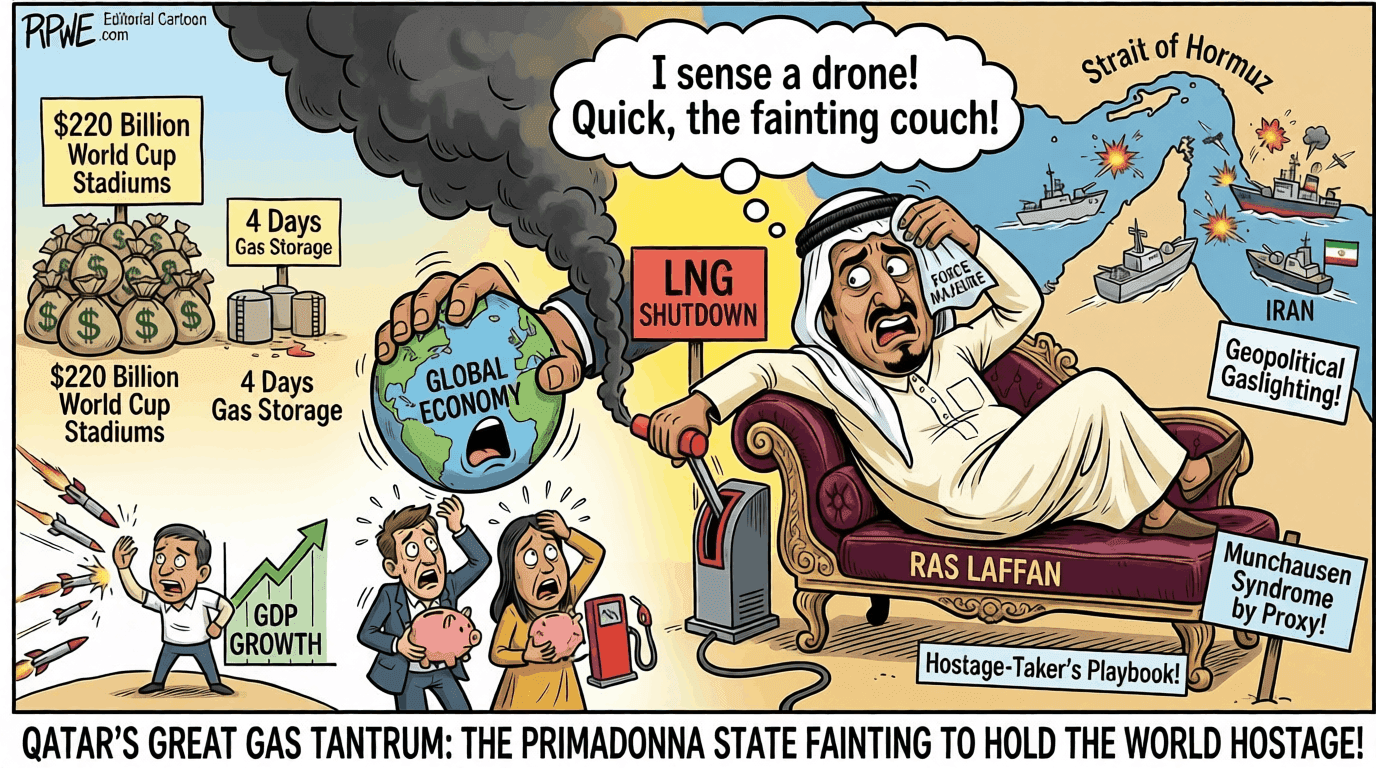
THE CARTEL OF CHAOS: QATAR LECTURES THE WORLD ON DRUGS WHILE SMUGGLING IDEOLOGICAL NARCOTICS

Welcome back to the Geopolitical Theater of the Absurd, where the world’s most prolific sponsors of ideological radicalism put on bespoke Italian suits, fly private jets to European capitals, and lecture the rest of us on moral purity.

If you want to witness a masterclass in parasitic statecraft, absolute cognitive dissonance, and the kind of staggering hypocrisy that could bend the laws of physics, look no further than the latest dispatch from the state-run Qatar Tribune.

The headline reads like an Onion article that accidentally made it to the printing press: “Qatar affirms commitment to boosting intl cooperation against world’s drug problem.”

Yes, you read that correctly. The State of Qatar—the geopolitical sugar daddy of the Muslim Brotherhood, the luxury concierge for Hamas, and the diplomatic shield for the Taliban—recently stood before the international community to express its deep, unwavering, and profound concern about... narcotics.

According to the official state propaganda, Qatari diplomats recently took to the podium at a global forum to boast about their “comprehensive and multidisciplinary approach” to fighting the global drug trade. They pontificated about the necessity of “shared responsibility,” the importance of “border security,” and their noble dedication to protecting the youth from the ravages of addiction.

Qatar pretending to care about the global drug problem is the geopolitical equivalent of Al Capone lecturing the local PTA on the dangers of jaywalking. It is a spectacular, breathtaking grift. And we at That’s Qatarted! are here to dissect exactly how the Primadonna of the Persian Gulf uses this bureaucratic theater to gaslight the entire planet.

Grab your coffee and settle in. We are going to take a very long, very deep dive into the anatomy of a geopolitical cartel.

THE DIPLOMATIC KABUKI DANCE

To truly appreciate the absurdity of the Qatari position, you have to picture the scene. Imagine the mahogany-lined halls of an international UN convention in Vienna or Geneva. The air is thick with expensive cologne and the meaningless, sterilized buzzwords of global diplomacy.

A Qatari diplomat, impeccably dressed, steps to the microphone. He looks out at the assembly of international law enforcement officials and NGOs, and with a completely straight face, declares that the State of Qatar is deeply committed to “combating the transnational networks that threaten global security and stability.”

The absolute gall. The unmitigated, staggering hubris.

Let us decode the diplomatic doublespeak. When Qatar talks about “border security” and stopping “transnational networks,” what they actually mean is that they are highly efficient at arresting a terrified, underpaid migrant worker from South Asia who accidentally brought a bottle of codeine cough syrup through Hamad International Airport. They will throw the book at a transit passenger for possessing half a gram of hashish, citing their absolute zero-tolerance policy for illicit substances. They will parade this statistic around the United Nations as proof of their unwavering moral fortitude.

But what happens when the “transnational network” isn’t a low-level weed smuggler, but a multi-billion dollar terror syndicate?

Suddenly, Qatar’s “zero-tolerance” policy evaporates into the desert wind. Suddenly, they become the champions of “nuance,” “context,” and “diplomatic engagement.”

If you smuggle a joint into Doha, you go to a sweltering prison. If you smuggle Iranian-funded ballistic missiles into Gaza, or orchestrate the hostile takeover of Kabul, or launder hundreds of millions of dollars for the Muslim Brotherhood, Qatar doesn’t arrest you. Qatar gives you a five-star suite at the Sheraton, a diplomatic passport, and a dedicated slot on Al Jazeera to broadcast your manifesto.

They stand before the world and demand international cooperation to stop the trafficking of chemicals, while they actively finance and facilitate the trafficking of human misery, chaos, and terror.

THE CAPTAGON ELEPHANT IN THE ROOM

Let us dig a little deeper into the specific geopolitics of the Middle Eastern drug trade, because the irony here is so thick you could cut it with a scimitar.

If Qatar is so deeply concerned about the “world’s drug problem,” one might assume they are aggressively targeting the largest, most destructive narco-empire in their own backyard.

I am talking, of course, about the Captagon Caliphate.

For the uninitiated, Captagon is a highly addictive amphetamine that has become the financial lifeblood of the “Axis of Resistance.” The regime of Bashar al-Assad in Syria, operating in seamless coordination with the Iranian Islamic Revolutionary Guard Corps (IRGC) and the Lebanese terror group Hezbollah, has transformed the Levant into a massive, state-sponsored cartel. They produce billions of dollars’ worth of Captagon pills and flood them across the borders into Jordan, Saudi Arabia, and the broader Gulf, destroying the lives of millions of Arab youths in the process.

The Assad-Iran-Hezbollah nexus is the Pablo Escobar of the Middle East. They are a literal narco-terrorist syndicate.

And what is Qatar’s relationship with the primary architects of this narco-empire?

As we detailed in previous investigations, Qatar bends over backward to appease Tehran. Qatari Prime Minister Sheikh Mohammed bin Abdulrahman Al Thani recently went on television to declare that Qatar builds its relationship with Iran “in good faith.” Qatar shares the world’s largest natural gas field with Iran. Qatar routinely acts as Iran’s diplomatic defense attorney in Washington, desperately trying to protect the Ayatollah’s regime from American and Israeli military pressure.

So, let’s get this straight. Qatar goes to the United Nations to lecture the globe on the catastrophic dangers of drug smuggling, while simultaneously running interference and providing diplomatic cover for the very regime (Iran) that sponsors the most prolific drug-smuggling terror militia (Hezbollah) on the planet.

Qatar has absolutely no problem with “transnational networks” poisoning the youth of the Middle East, so long as those networks belong to their geopolitical allies. They will condemn the drugs, but they will happily cuddle the drug lords. It is a masterpiece of geopolitical gaslighting.

The Puritanical Pusher

Ultimately, the most fascinating aspect of this war on drugs is what it reveals about the psychology of the Qatari elite.

How does a state reconcile this extreme duality? How do they enforce brutal, puritanical order at home, while actively funding and fueling chaos, revolution, and destruction abroad?

This is the Paradox of the Puritanical Pusher.

Every successful drug cartel operates on one fundamental rule: Never get high on your own supply.

The Qatari leadership understands this perfectly. Inside the borders of Qatar, there is no revolution. There is no protesting. There is absolutely no tolerance for the kind of radical, destabilizing Islamist agitation that Al Jazeera promotes 24/7 in neighboring countries like Egypt, Syria, or Saudi Arabia. If a Qatari citizen tried to organize a Muslim Brotherhood rally in downtown Doha, or set up a protest encampment demanding the overthrow of the Emir, they would be disappeared into a state security dungeon faster than you can say “Force Majeure.”

Qatar demands absolute, iron-fisted stability at home. They want pristine streets, endless luxury, and a completely docile population.

But for the rest of the world? For the rest of the world, Qatar exports the poison.

They export the ideological narcotics of Islamism to the Arab world to keep their regional rivals weak and distracted. They export the ideological narcotics of “woke” grievance studies to the West to fracture American society and ensure the U.S. remains deeply divided and entirely dependent on Qatari “mediation” to solve the very crises Qatar helped create.

They are the neighborhood drug dealer who lives in a gated mansion, keeps his own children completely isolated from the streets, and then makes his billions by selling crack to the kids on the other side of town.

And then, just to rub salt in the wound, he puts on a suit, drives to the local town hall meeting, and gives a 45-minute speech on his “unwavering commitment to boosting international cooperation against the world’s drug problem.”

It is a level of sociopathic statecraft that borders on art.

The Internation Enablers

The international community sits in these UN forums, clapping politely as the Qatari delegation delivers its meaningless platitudes about fighting the drug trade. The Western diplomats nod along, desperately hoping that if they humor the Emir, maybe Qatar will lower the price of LNG, or maybe they will graciously ask Hamas to release a few of the hostages that Qatar itself helped finance.

The West is playing a bureaucratic game of checkers, while Qatar is playing a multidimensional game of civilizational chess.

Qatar doesn’t care about the global drug problem. They only care about maintaining their status as the indispensable arsonist and the indispensable firefighter. They will continue to arrest the low-level smugglers at their airport to maintain the illusion of law and order, while operating the most sophisticated ideological smuggling ring in the history of the modern world.

They will keep addicting our universities, corrupting our media, and shielding our enemies. And they will do it all with a smile, a bespoke suit, and a perfectly worded press release in the Qatar Tribune.

The Pacificist of the Persian Gulf: Or How the Qataris Discovered “Human Rights” the Second an Iranian Missile Ruined Their Brunch

Welcome back to the Geopolitical Theater of the Absurd, where the death of truth is not just a daily occurrence, but a heavily subsidized state enterprise.

If you want to witness a clinical case study in staggering cognitive dissonance, look no further than the diplomatic pantomime currently playing out in Doha. This week, the Islamic Republic of Iran—the undisputed heavyweight champion of regional destabilization—decided to skip the proxy middlemen and launched a barrage of nine ballistic missiles and a swarm of suicide drones directly at the State of Qatar.

And how did the mighty Qatari regime respond? The same regime that has spent decades acting as the financial concierge for every radical Islamist terror syndicate on the planet? Did they project raw power? Did they unleash a terrifying military retaliation?

No.

They retreated to a luxury conference room, turned on the microphones, and hosted an urgent meeting of the “Arab Network for National Human Rights Institutions” (ANNHRI) to cry about the “absolute ban on the use of force.”

You simply cannot make this up. The absolute, unmitigated gall required to pull off this level of geopolitical gaslighting is a marvel of human psychology. We at That’s Qatarted! are here to dissect this masterpiece of hypocrisy, strip away the sterilized United Nations jargon, and expose the farcical reality of Qatar’s newfound pacifism.

The Doha Parasite

To truly understand what is happening here, we must diagnose the neurological pathogen infecting the Qatari elite. It is a unique disease of the mind, a parasitic infection that completely obliterates the host’s capacity for self-awareness, logic, and shame. Let us call it the Doha Parasitic Syndrome.

For twenty years, the State of Qatar has operated as the sugar daddy of jihad. They provided five-star hotel suites to the billionaire leaders of Hamas. They funded the Taliban. They bankrolled the Muslim Brotherhood. They utilized their state-run megaphone, Al Jazeera, to pump ideological toxins into the Arab bloodstream, glorifying “martyrs” and framing the mass murder of civilians as “holy resistance.”

When Hamas or Palestinian Islamic Jihad launched tens of thousands of unguided rockets into Israeli cities, did Qatar convene an urgent human rights summit to condemn the “use of force”? Of course not. When the violence was directed at the Jewish state, the Qatari elites viewed the use of force as a divine obligation. It was celebrated. It was the “decolonization” they so gleefully pay American universities to teach.

But the very millisecond the Iranian crocodile turns around and snaps its jaws at Doha? The moment a ballistic missile enters the airspace above the designer boutiques of the Pearl-Qatar?

Suddenly, the Qatari leadership undergoes a miraculous, instantaneous metamorphosis. The financiers of holy war transform into the reincarnations of Mahatma Gandhi. Suddenly, they are clutching their pearls, hyperventilating about “international law,” and pleading with the global community to enforce an “absolute ban on the use of force.”

This is the ultimate murder of truth. They demand that the West applies a strict, utopian set of human rights standards to protect Qatari sovereign airspace, while simultaneously funding the barbarians who explicitly seek to dismantle Western civilization. It is ideological parasitism at its finest: they weaponize the moral compass of the free world to shield themselves from the very monsters they helped create.

The “Real” Middle East versus the Mahogany Suites

Let us cut through the BS and look at this through the lens of the actual, unfiltered Middle East. Not the fantasy version peddled by blue-haired sociology professors in the West, but the raw, unforgiving reality of the Arab world.

In this neighborhood, respect is not earned through nicely worded resolutions or “human rights networks.” This is a region that operates strictly on the tribal dynamics of honor, shame, and the big stick. The strong eat the weak, and the weak pay tribute to survive.

The guys sitting in the shisha cafes in Cairo, Amman, and Baghdad - the real “Arab street” - are looking at Qatar right now and laughing. They know the score. They know that Qatar is a micro-state with a massive bank account and a glass jaw. For years, Qatar thought it could play the regional tough guy by outsourcing its violence. They thought they could buy their way out of the tribal reality by purchasing European soccer teams, bribing Western politicians, and funding radical militias to destabilize their neighbors.

They truly believed their money and their Ivy League connections made them immune to the rules of the jungle.

But Iran just delivered a brutal reality check. Tehran doesn’t care about your investments in London real estate. Tehran doesn’t care about your public relations campaigns. By firing missiles at Doha, the Ayatollahs are asserting dominance the old-fashioned way. They are showing the entire Arab world that when push comes to shove, Qatar is utterly defenseless.

And how does Qatar react to this public humiliation? They whine to international NGOs. In the honor-shame culture of the Middle East, there is nothing more pathetic than a supposed power broker running behind the skirt of the United Nations the moment they get punched in the mouth. The Arab street respects power. Qatar responds to power with press releases.

The Comedy of the “Arab Human Rights” Cabal

We must take a moment to savor the pure, unadulterated comedic genius of the ANNHRI meeting itself.

First of all, the concept of an “Arab Network for National Human Rights Institutions” headquartered in Doha is an oxymoron so profound it threatens to rip a hole in the space-time continuum. Hosting a human rights summit in the Persian Gulf is like hosting a women’s rights convention in Kabul, or a vegan food festival inside a slaughterhouse.

This is a region where journalists are occasionally dismembered for writing critical articles. This is a country where migrant workers are treated as disposable, indentured props to build World Cup stadiums. And yet, there they were, sitting in their air-conditioned conference rooms, talking about “civilian rights” and “humanitarian rules-based orders.”

During the meeting, the Chairman of the network, Eng. Ali Ahmed Al Derazi, condemned the Iranian missile strikes as “full-scale aggression, devoid of ethical or legal justification.”

Let that sink in. The State of Qatar, which has acted as the primary diplomatic shield for the October 7th massacres—an event that was the literal definition of full-scale aggression devoid of ethical justification—is now lecturing the region on ethics.

Another official at the meeting warned of the “risks posed by ongoing cross-border attacks in undermining human rights.”

Where was this profound concern for cross-border attacks when Hezbollah was firing anti-tank missiles into northern Israel every single day for the past two years? Where was this desperate need for “accountability mechanisms” when the Houthis—who are armed by the very same Iranians currently bombing Qatar—were holding the global shipping industry hostage in the Red Sea?

To the Qatari elite, “human rights” is not a moral framework. It is merely a linguistic tool, a fashionable accessory they put on when they need to play the victim, and discard the moment it becomes inconvenient for their Islamist agenda.

The Hypocrisy of “Civilian Infrastructure”

The crowning jewel of the ANNHRI summit was the outrage over the targeting of civilian infrastructure. The participants dramatically condemned the “methodical targeting of critical infrastructure, including energy facilities, airports, and water stations.”

It is truly touching to see Doha suddenly discover the sanctity of civilian infrastructure.

Let’s review the tape. Qatar funds and directs Hamas. Hamas’s entire military doctrine is predicated on building vast subterranean terror networks directly underneath civilian infrastructure. They place their rocket launchers next to schools. They put their command centers under hospitals. They store their ammunition in residential apartment buildings. Qatar knows this. Qatar paid for it. They purposefully subsidized a terror strategy that explicitly uses Palestinian civilians as human shields to maximize the PR value of dead bodies.

But when an Iranian drone gets a little too close to the Hamad International Airport? When a piece of missile debris falls near the industrial zone in Doha?

Suddenly, civilian infrastructure is a sacred, inviolable temple of humanity! Suddenly, the international community must immediately intervene to protect the vital energy facilities of the Qatari state!

The absolute brazenness of it all. They are demanding that the world treats Qatari LNG facilities as untouchable humanitarian zones, while they finance the militarization of every hospital and school in the Gaza Strip. It is a level of sociopathic statecraft that belongs in a textbook.

The Coward Bully

At the end of the day, the ANNHRI meeting in Doha is nothing more than a desperate, cowardly plea for the West to step in and save Qatar from the consequences of its own actions.

For decades, Qatar has played a deadly, duplicitous game. They believed they could be the arsonist and the firefighter simultaneously. They believed they could feed the Iranian crocodile, arm the Islamist extremists, and slowly destabilize the entire region, all while safely hiding behind the American military base at Al Udeid.

They thought they had domesticated the monsters of the Middle East. But the monsters are off the leash, and they are hungry. The ballistic missiles intercepted over Doha are a wake-up call that the Qatari royals cannot comprehend.

Instead of looking in the mirror and realizing that their sponsorship of radicalism has finally come home to roost, they retreat into the semantic nonsense of “human rights” diplomacy. They want the United Nations to write a sternly worded letter to the Ayatollahs. They want “awareness campaigns.”

It is the dying gasp of a failed geopolitical strategy. You cannot preach the absolute ban on the use of force when your entire national brand is built on funding the forceful destruction of others. The world is finally seeing Qatar for what it truly is: a fragile, hypocritical cartel that cries like a victim the moment the violence it sponsors is aimed in its direction.

That’s Qatarted!

THE UMBRELLA OF THE UMMAH: QATAR LECTURES AMERICA WHILE CUDDLING THE AYATOLLAH

Welcome back to the Geopolitical Theater of the Absurd, where the arsonist complains about the smoke, the victim apologizes to the mugger, and the State of Qatar tells the United States military how to do its job.

If you want to witness a masterclass in cognitive dissonance and parasitic statecraft, look no further than the recent Sky News / YouTube interview with Qatari Prime Minister Sheikh Mohammed bin Abdulrahman Al Thani.

Sitting safely in his pristine Doha office—protected by American and British fighter jets—the Prime Minister addressed the recent barrage of Iranian ballistic missiles and drones raining down on his country. And his response? A spectacular, spineless cocktail of fake shock, appeasement, and the audacity to lecture the West.

The “Shocking” Betrayal

Let’s start with the comedy of errors. Speaking about the Iranian missile strikes, Sheikh Mohammed clutched his proverbial pearls and stated: “We never expected this to come to us from our neighbor... we were always building this relationship in preserving the good neighborhood and relationship in a good faith with Iran.”

Stop. Freeze frame.

You didn’t expect this? You, the nation that has spent decades acting as the financial and diplomatic concierge for every radical Islamist terror group in the Middle East, are shocked that the world’s leading state sponsor of terrorism acted like a terrorist state?

Qatar spent years feeding the Iranian crocodile, hoping it would eat them last. They shared the world’s largest gas field, they helped Tehran bypass sanctions, and they happily acted as Hamas’s Sugar Daddy in coordination with the IRGC. But the moment the Ayatollah decides to turn the rockets on Doha, Qatar acts like a betrayed prom date. “But we acted in good faith!” Newsflash to Doha: You cannot build a “good faith” neighborhood watch program with a regime whose entire geopolitical operating system is based on exporting violent Islamic revolution.

The Chihuahua Lectures the Pitbull

But the absolute pinnacle of Qatari delusion comes when the Prime Minister pivots to lecturing the United States and the international community.

Despite the fact that the UK’s RAF and the US military are currently the only things keeping Doha from becoming a smoking crater (a fact the PM casually glided over by mentioning a “joint squadron” with British pilots), Qatar is now demanding that “all sides must de-escalate.”

Wait, what?

Iran launches unprovoked ballistic missiles at your capital, forces your airport to shut down, and threatens 20% of the world’s LNG supply... and your message is that America needs to de-escalate?

Sheikh Mohammed literally stated he wants a diplomatic solution “that addresses our concerns as well as their concerns.” What exactly are Iran’s “concerns” here? That they missed the luxury boutiques at the Pearl-Qatar? That their drones didn’t kill enough expats? The fact that a Qatari leader is validating the “concerns” of a regime that just tried to blow up his country is a testament to the ideological pathogen infecting the Gulf.

He even sent a message to Iran pleading with them not to involve other countries, so that Qatar can “be able to be helped in de-escalating the situation.” Translation: Please stop shooting at us, so we can go back to the UN and defend you against the mean Americans and Israelis.

The Brotherhood of the Ummah

Why is Qatar playing this pathetic double game? Why won’t they come out and unequivocally condemn the Islamic Republic and call for its dismantling?

Because behind closed doors, despite the sectarian window-dressing, Doha and Tehran share the exact same ridiculous, archaic agenda.

Yes, Iran is the vanguard of Shia extremism (Khomeinism), and Qatar is the bankroller of Sunni extremism (the Muslim Brotherhood). To the untrained Western eye, they are mortal enemies. But in reality, they are ideological cousins engaged in a violent family dispute over who gets to sit at the head of the table.

Both regimes fundamentally believe in the supremacy of the Islamic Ummah. Both regimes despise Western secular democracy. Both regimes view Israel as a cancerous tumor that must be eradicated. And both regimes enthusiastically fund Hamas to do the dirty work.

They are two sides of the same Islamist coin. Qatar doesn’t want the US to destroy the Iranian regime because, at their core, the Qatari elite share Tehran’s ultimate civilizational goals. They just prefer to achieve those goals by buying American universities and Western politicians, rather than launching missiles.

Qatar wants the American umbrella of protection, but they want to keep the Iranian umbrella of the Ummah. They want US taxpayer-funded missile defense systems to shoot down Iranian drones, so that Qatari diplomats can safely return to a mahogany table to appease the Ayatollah.

It is the ultimate geopolitical grift. And the West is falling for it, hook, line, and sinker.

Who paid for the epiphany?

That’s Qatarted!

Qatar’s Great Gas Tantrum How the Persian Gulf’s Primadonna Faked a Faint to Hold the World Hostage

Ah, Qatar. The tiny speck on the map that’s somehow convinced the world it’s the indispensable sugar daddy of global energy. But let’s peel back the layers of this desert mirage, shall we? In the midst of a U.S.-Israeli smackdown on Iran – a conflict that’s got more plot twists than a poorly scripted telenovela – Qatar decides to pull the plug on its gas liquefaction operations. Not because of some catastrophic hit to their infrastructure, mind you. No exploding refineries, no cyber hacks turning valves into digital confetti. Just the mere whisper of trouble in the Strait of Hormuz, and poof! Twenty percent of the world’s liquefied natural gas (LNG) vanishes into thin air, courtesy of a self-inflicted shutdown. Declare force majeure, they say. Blame the war, they whine. But we here at That’s Qatarted! smell something fouler than sulfur in the air – it’s the stench of geopolitical gaslighting, served with a side of Munchausen syndrome by proxy, where the “proxy” is the entire global economy.

This isn’t just a hiccup in supply chains; it’s a masterclass in fragility disguised as fortitude. Drawing from the wisdom of Nassim Taleb, whose antifragility concept reminds us that true strength thrives on chaos, not cowers from it, we’ll dissect how Qatar embodies the antithesis: a primadonna state that wilts at the first sign of a geopolitical breeze. While Israel absorbs rocket barrages like a sponge and emerges economically stronger, Qatar spots a drone on the horizon and immediately calls for the fainting couch. And why? To extort the West into saving their ideological bedfellows in Tehran. It’s blackmail, pure and simple, wrapped in the silky robes of “force majeure” clauses and technical jargon about “thermal shock.” But fear not, dear readers – we’re about to embark on a verbose, venomous voyage through this farce, chapter by chapter, exposing the hypocrisy with the precision of a surgeon wielding a sarcasm scalpel.

The Fainting Couch of Ras Laffan

Picture this: Ras Laffan, Qatar’s gleaming industrial jewel, a sprawling complex of pipes and tanks that’s supposed to be the beating heart of their LNG empire. Built with billions from oil sheikhs who treat money like confetti at a wedding, it’s designed – or so they claim – to churn out super-chilled gas at a rate that could power half of Asia. But on March 4, 2026, as Reuters breathlessly reports, state-owned Qatar Energy (QE) hits the panic button. Full shutdown of gas liquefaction. Force majeure declared on exports. Why? Because shipping in the Strait of Hormuz has “ground to a near-halt” amid the U.S.-Israeli war on Iran and Tehran’s predictable retaliation. No ships mean no exports, they say, and thus, no point in liquefying gas. The tanks will fill up in just four days at full production rate – a measly 1,880,000 cubic meters of storage, which, in the grand scheme of their output, is like having a kiddie pool as your reservoir for Niagara Falls.

But hold on – is this really an unavoidable catastrophe, or the geopolitical equivalent of a Victorian lady swooning at the sight of an ankle? Qatar, with its $200 billion sovereign wealth fund and a GDP per capita that makes Swiss bankers blush, couldn’t invest in a bit more storage? Or, heaven forbid, diversify their export routes? No, instead, they opt for the dramatic flair: shut it all down, declare an “event beyond our control,” and watch the world scramble. Sources – anonymous, of course, because who wants to be named in this charade? – tell Reuters it might take at least a month to get back to normal. Two weeks before they even think about restarting, and another two to ramp up, all to avoid “thermal shock” to the equipment. Thermal shock! As if these multi-billion-dollar trains are delicate Fabergé eggs that shatter if you look at them funny.

This fainting couch routine isn’t new for Qatar. Remember how they hosted the 2022 World Cup, spending $220 billion on stadiums that now gather dust like forgotten pharaoh tombs? All that cash, and yet their energy infrastructure is so fragile that a shipping snag – not even a direct attack – sends them into hysterics. It’s almost as if they’ve engineered this vulnerability on purpose, a built-in kill switch to weaponize when the winds of war blow unfavorably. And who suffers? Europe and Asia, their primary customers, now facing multi-year high gas prices and freight rates. China, Japan, India, South Korea – all left twisting in the wind, while Qatar plays the victim. Geopolitical Munchausen at its finest: fake an illness (industrial shutdown) to garner sympathy (and leverage) from the international community. But as we’ll see, this is no innocent ploy; it’s a calculated hijacking of the global supply chain.

The Tale of Two Economies

Now, let’s pivot to a stark contrast that would make even Nassim Taleb chuckle in approval: the antifragile beast that is Israel versus the glass-jaw fragility of Qatar. Israel, that plucky underdog in a sea of hostility, has been eating rockets for breakfast since its inception. Over 10,000 missiles lobbed by Hamas, Hezbollah, and now potentially Iran-backed proxies – and what happens? Their GDP grows. Tech hubs in Tel Aviv hum along, Iron Dome intercepts threats like a video game on easy mode, and the economy? It expands by leaps and bounds. In 2023 alone, amid escalating tensions, Israel’s high-tech sector attracted billions in investments, proving Taleb’s point: systems that gain from disorder become antifragile. Chaos isn’t a bug; it’s a feature that hones resilience.

Qatar? Oh, please. The primadonna of the Persian Gulf spots a shadow in the Strait – not even a direct hit, mind you – and collapses into a heap. No antifragility here; just systemic brittleness masquerading as sophistication. Their entire LNG operation, accounting for 20% of global exports, hinges on a single chokepoint: the Strait of Hormuz. One whiff of conflict, and they declare force majeure, freeing themselves from contractual liabilities while the world pays the price. It’s like building a mansion on a fault line and then acting shocked when the earth quakes.

Evidence of Hypocrisy:

- World Cup Waste vs. Infrastructure Neglect: Qatar blew $220 billion on soccer extravaganzas, complete with air-conditioned stadiums in the desert heat. But storage tanks? Barely enough for four days’ worth. Prioritize parties over practicality – classic Qatari move.

- Terror Financing Double Standards: While Qatar funds groups like Hamas (hello, hostage negotiations!), they cry foul when war disrupts their exports. Antifragile? Hardly. They’re the sugar daddies enabling fragility elsewhere while feigning their own.

- Economic Dependence as a Weapon: Israel diversifies – tech, defense, agriculture. Qatar? All eggs in the gas basket, deliberately so, to use it as a geopolitical cudgel.

This tale underscores a deeper truth: true power lies in adaptability, not monopoly. Israel thrives because it must; Qatar whines because it can. And in this shutdown, we’re witnessing the ultimate fragility exploit: turn your weakness into the world’s problem.

The Physics of Hypocrisy

Ah, the technical excuses – where the sarcasm really ramps up. Reuters quotes experts like Mehdy Touil from Calypso Commodities, waxing poetic about the “shutdown process”: reduce production gradually, stop feedgas flows, ease pressure to protect equipment. Then, the restart: a slow cooldown to avoid “thermal shock,” sequencing trains one by one. It sounds so scientific, so unavoidable. But let’s apply a Talebian lens: this isn’t physics; it’s hypocrisy in a lab coat.

First, the storage farce. 1,880,000 cubic meters – impressive on paper, but at full production, it fills in four days. For a nation that liquifies gas at -162 degrees Celsius, this is the equivalent of a five-star chef with a microwave for storage. Qatar, with its endless dunes of cash, couldn’t build bigger tanks? Or underground storage like the U.S. does with its strategic reserves? No, because that would rob them of the excuse to shut down. The “thermal shock” bit is even richer. Equipment damage from rapid restarts? Sure, in theory. But these are state-of-the-art facilities run by engineers who, presumably, know their thermodynamics. Yet suddenly, amid a war threatening their Tehran ties, they forget how to operate without a month-long siesta?

This is Geopolitical Munchausen in action: fabricating an “industrial illness” for attention and gain. Qatar isn’t shutting down because they have to; they’re doing it because they want to. The force majeure clause? A get-out-of-jail-free card for when “events beyond control” – like backing the wrong horse in Iran – bite back. And the hypocrisy? Qatar preaches sustainability and innovation (remember their AI-pushing at global forums?), yet their restart protocol is as antiquated as a steam engine. Slow sequencing to avoid shock? In 2026, with AI optimizing everything from traffic to trading, they can’t automate a safer ramp-up?

The Evidence:

- Selective Fragility: Qatar’s plants run near full capacity peacetime, no issues. War whispers? Sudden “thermal vulnerabilities.” Convenient.

- Expert Gaslighting: Touil’s AI company peddles LNG solutions, yet Qatar ignores them for drama. Who benefits? Prices skyrocket, Qatar’s leverage soars.

- Historical Precedents: In 2022’s energy crisis, Qatar ramped up without fanfare. Now? A month minimum. Smells like political theater.

The physics here isn’t about molecules; it’s about power dynamics. Qatar’s feigned fragility is a smokescreen for extortion.

The Strategic Bottleneck

Delving deeper, this shutdown isn’t accidental; it’s architected. Qatar has intentionally built a system where they control the world’s throttle. All exports through Hormuz – a 21-mile-wide strait that’s a perpetual flashpoint. Why not pipelines to Oman or Saudi Arabia? Or LNG terminals elsewhere? Because bottlenecks are power. By monopolizing this chokepoint, Qatar can “hijack” supply chains at will.

This is the Hostage-Taker’s Playbook, perfected by a nation infamous for funding terror and negotiating hostages (Hamas, anyone?). Now, they’re holding economies hostage: Asia and Europe, over 80% of their customers, face shortages. Gas prices hit multi-year highs, freight rates explode. Saul Kavonic from MST Marquee nails it: “Nothing can replace Qatari LNG.” Exactly – that’s the point. The U.S., top producer, can’t offset quickly; plants at capacity, contracts locked.

Why engineer this? To blackmail the West: stop the war on Iran, or watch your energy bills detonate. Qatar’s ties to Tehran run deep – shared gas fields, ideological alignments. This shutdown? A proxy strike, using economic warfare to aid their buddies. It’s TaskRabbit spying on steroids: outsource disruption to “force majeure,” reap the rewards.

Evidence of Hypocrisy:

- Diversification Dodge: Qatar lectures others on economic reform (Vision 2030 echoes), yet clings to Hormuz dependence.

- Woke Diplomacy Cover: They cloak extortion in “beyond control” legalese, while funding chaos creators.

- Global Impact Ignored: Claim victimhood, but inflict pain on Pakistan, India – poor nations they pretend to champion.

This bottleneck is Qatar’s ace: fragility as strategy.  Now That’s Qatarted!

THE DOHA DOUBLE STANDARD: QATAR DISCOVERS THE JOY OF AIRSTRIKES (WHEN IT’S THEIR OWN ATM ON THE LINE)

Welcome back to the Geopolitical Theater of the Absurd, where the arsonist is suddenly crying to the UN because the fire finally reached his own curtains.

For the last two decades, the State of Qatar has been the sanctimonious hall monitor of the Middle East. Whenever Israel faced unprovoked rocket barrages, suicide bombings, or massacres orchestrated by Iranian-funded proxies, Doha was the first to grab the microphone. 

Through their state-run megaphone, Al Jazeera, they lectured the globe about “maximum restraint,” “the cycle of violence,” and the moral imperative of “de-escalation.”

Defending your own borders, according to the Qatari diplomatic playbook, was a horrific “escalation.”

But what happens when the Ayatollah decides to skip the proxies and fire directly at the Al Thani family’s piggy bank?

According to a breathless, sweaty press briefing from Qatari Foreign Ministry spokesperson Majed Al-Ansari this Tuesday, Iran just launched a massive strike on Qatari territory. We aren’t talking about a skirmish in an empty desert; Iran targeted Doha airport, civilian areas, and the absolute crown jewels of the Qatari empire: the Liquefied Natural Gas (LNG) facilities.

Suddenly, Doha’s diplomatic vocabulary has undergone a miraculous, hawkish transformation. It turns out “restraint” is for the peasants.

The Sudden Death of “Proportionality”

When Hamas fires thousands of rockets into Israeli cities, Qatar dispatches an envoy to talk about “context” and “root causes.”

But when an Iranian missile lands a little too close to the Louis Vuitton duty-free boutique at Hamad International Airport?

“The attack on our sovereignty... has already crossed every possible red line,” thundered Al-Ansari, suddenly sounding exactly like the Israeli Defense Ministers he has spent his entire career condemning. “We reserve the right to retaliate.”

Wait, what happened to sitting down at a mahogany table in Geneva to discuss the “nuance” of Iran’s grievances? What happened to the “cycle of violence”?

Apparently, “context” is only intellectually stimulating when the rockets are landing on Tel Aviv. When they threaten Qatar’s Wi-Fi, the gloves come off. Doha didn’t just write a sternly worded letter to the UN—they shot down two Iranian fighter jets that entered their airspace.

Where are the American university students pitching tents on the quad to protest Qatari aggression against Iranian pilots? Where are the UN resolutions demanding Doha lay down its arms and accept a ceasefire? Crickets

The “Grave Danger” to the Royal Wallet

The hypocrisy reaches absolute terminal velocity when Al-Ansari discusses the economic impact. Because Iran forced the temporary closure of Qatar’s LNG facilities, Doha is now frantically warning of a “grave danger to international economies.”

Let’s get this straight. For years, Qatar has funded, hosted, and shielded groups like the Houthis and Hamas, who have systematically disrupted global shipping in the Red Sea, paralyzed supply chains, and cost the global economy billions. Doha called that “resistance.”

But the second someone touches Qatar’s gas pipelines? The holy fountain of their sovereign wealth? It is an international crisis of apocalyptic proportions! Help us, the world economy is suffering! (Translation: Our quarterly profit margins are dipping, please send an American aircraft carrier).

The Irony of the 8,000 “Stranded” Passengers

Perhaps the most jaw-dropping moment of the briefing was Al-Ansari lamenting that Doha’s airspace is closed, leaving more than 8,000 transit passengers stranded and “hosted” inside the country.

While it is undeniably frustrating for those travelers, the irony of Qatar complaining about people being held against their will on their territory is almost too rich for human consumption.

Qatar has spent decades hosting the billionaire leadership of terror groups whose primary tactical innovation is taking actual, literal hostages. Doha is suddenly highly sensitive to the plight of people who just want to go home; unless, of course, you’re an Israeli toddler or an American citizen dragged into a tunnel, in which case Doha prefers to call you a “bargaining chip” while treating your captors to five-star room service at the Sheraton.

The “Resistance” Bites the Hand That Feeds It

Al-Ansari made it very clear: “Retaliation is firmly on the table... Qatar is able to stop any entity that is trying to attack.” He boasted about having “enough air-defense missiles to deal with any attack.”

It is a stunning, glorious pivot. The nation that practically invented the modern “Diplomacy of Delay” to protect terror groups from facing military consequences is now proudly rattling its own sabers.

Qatar played a highly lucrative, highly dangerous game for twenty years. They believed they could fund the extremists, host the clerics, and incite the entire region via Al Jazeera, all while remaining perfectly immune inside their glass towers because they let the US park some jets at Al Udeid. They truly believed they were the untouchable puppet masters.

But as the air-raid sirens wail over the LNG facilities, Doha has learned a brutal, unavoidable lesson: To the Islamic Republic of Iran, you aren’t a trusted ally. You are just a remarkably wealthy target with a glass jaw.

Welcome to the real Middle East, Qatar. We hear the “cycle of violence” is lovely this time of year.

That’s Qatarted!

With wit and humor, we expose that the emperor has no clothes… and Qatar is the tailor.

With wit and humor, we expose that the emperor has no clothes… and Qatar is the tailor.

With wit and humor, we expose that the emperor has no clothes… and Qatar is the tailor.

The truth is so surreal it also demands a humorous take. When a country that outlaws homosexuality hosts a gay influencer at the “Global Diversity Summit,” That’s Qatarted! When a nation built on the backs of modern-day indentured servitude lectures the West on human rights? That’s Qatarted!

Newsletter

Subscribe now to get sharp, irreverent updates and deep‑dive breakdowns that cut through Qatar’s PR fog and keep you one step ahead of the gaslighting.

You're in! Thank you.

That's Qatarted!

© 2026

All Rights Reserved.

The truth is so surreal it also demands a humorous take. When a country that outlaws homosexuality hosts a gay influencer at the “Global Diversity Summit,” That’s Qatarted! When a nation built on the backs of modern-day indentured servitude lectures the West on human rights? That’s Qatarted!

Newsletter

Subscribe now to get sharp, irreverent updates and deep‑dive breakdowns that cut through Qatar’s PR fog and keep you one step ahead of the gaslighting.

You're in! Thank you.

That's Qatarted!

© 2026

All Rights Reserved.

The truth is so surreal it also demands a humorous take. When a country that outlaws homosexuality hosts a gay influencer at the “Global Diversity Summit,” That’s Qatarted! When a nation built on the backs of modern-day indentured servitude lectures the West on human rights? That’s Qatarted!

Newsletter

Subscribe now to get sharp, irreverent updates and deep‑dive breakdowns that cut through Qatar’s PR fog and keep you one step ahead of the gaslighting.

You're in! Thank you.

That's Qatarted!

© 2026

All Rights Reserved.