Welcome back to the Geopolitical Theater of the Absurd, where the world’s most prolific sponsors of ideological radicalism put on bespoke Italian suits, fly private jets to European capitals, and lecture the rest of us on moral purity.
If you want to witness a masterclass in parasitic statecraft, absolute cognitive dissonance, and the kind of staggering hypocrisy that could bend the laws of physics, look no further than the latest dispatch from the state-run Qatar Tribune.
The headline reads like an Onion article that accidentally made it to the printing press: “Qatar affirms commitment to boosting intl cooperation against world’s drug problem.”
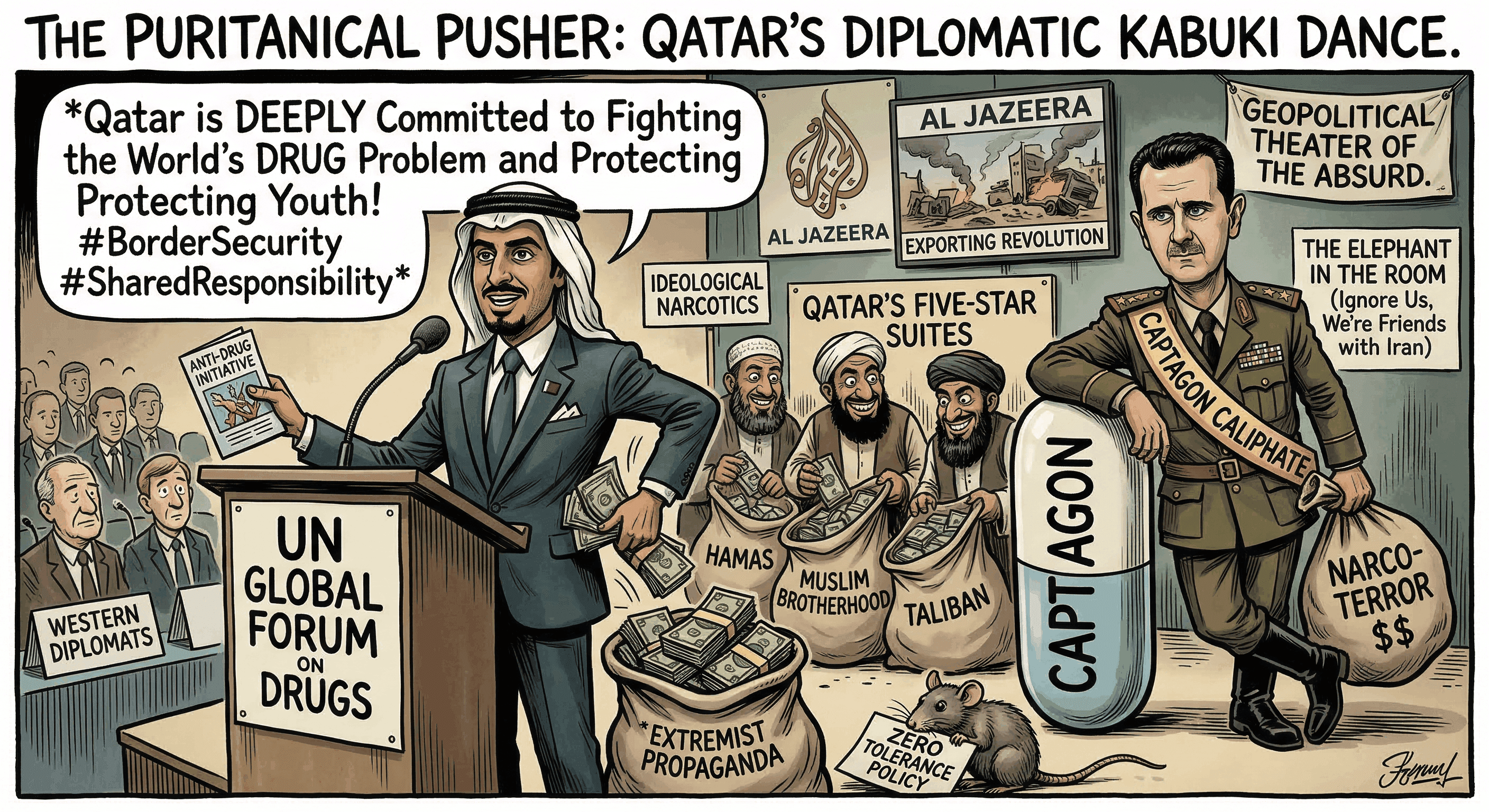
Yes, you read that correctly. The State of Qatar—the geopolitical sugar daddy of the Muslim Brotherhood, the luxury concierge for Hamas, and the diplomatic shield for the Taliban—recently stood before the international community to express its deep, unwavering, and profound concern about... narcotics.
According to the official state propaganda, Qatari diplomats recently took to the podium at a global forum to boast about their “comprehensive and multidisciplinary approach” to fighting the global drug trade. They pontificated about the necessity of “shared responsibility,” the importance of “border security,” and their noble dedication to protecting the youth from the ravages of addiction.
Qatar pretending to care about the global drug problem is the geopolitical equivalent of Al Capone lecturing the local PTA on the dangers of jaywalking. It is a spectacular, breathtaking grift. And we at That’s Qatarted! are here to dissect exactly how the Primadonna of the Persian Gulf uses this bureaucratic theater to gaslight the entire planet.
Grab your coffee and settle in. We are going to take a very long, very deep dive into the anatomy of a geopolitical cartel.
THE DIPLOMATIC KABUKI DANCE
To truly appreciate the absurdity of the Qatari position, you have to picture the scene. Imagine the mahogany-lined halls of an international UN convention in Vienna or Geneva. The air is thick with expensive cologne and the meaningless, sterilized buzzwords of global diplomacy.
A Qatari diplomat, impeccably dressed, steps to the microphone. He looks out at the assembly of international law enforcement officials and NGOs, and with a completely straight face, declares that the State of Qatar is deeply committed to “combating the transnational networks that threaten global security and stability.”
The absolute gall. The unmitigated, staggering hubris.
Let us decode the diplomatic doublespeak. When Qatar talks about “border security” and stopping “transnational networks,” what they actually mean is that they are highly efficient at arresting a terrified, underpaid migrant worker from South Asia who accidentally brought a bottle of codeine cough syrup through Hamad International Airport. They will throw the book at a transit passenger for possessing half a gram of hashish, citing their absolute zero-tolerance policy for illicit substances. They will parade this statistic around the United Nations as proof of their unwavering moral fortitude.
But what happens when the “transnational network” isn’t a low-level weed smuggler, but a multi-billion dollar terror syndicate?
Suddenly, Qatar’s “zero-tolerance” policy evaporates into the desert wind. Suddenly, they become the champions of “nuance,” “context,” and “diplomatic engagement.”
If you smuggle a joint into Doha, you go to a sweltering prison. If you smuggle Iranian-funded ballistic missiles into Gaza, or orchestrate the hostile takeover of Kabul, or launder hundreds of millions of dollars for the Muslim Brotherhood, Qatar doesn’t arrest you. Qatar gives you a five-star suite at the Sheraton, a diplomatic passport, and a dedicated slot on Al Jazeera to broadcast your manifesto.
They stand before the world and demand international cooperation to stop the trafficking of chemicals, while they actively finance and facilitate the trafficking of human misery, chaos, and terror.
THE CAPTAGON ELEPHANT IN THE ROOM
Let us dig a little deeper into the specific geopolitics of the Middle Eastern drug trade, because the irony here is so thick you could cut it with a scimitar.
If Qatar is so deeply concerned about the “world’s drug problem,” one might assume they are aggressively targeting the largest, most destructive narco-empire in their own backyard.
I am talking, of course, about the Captagon Caliphate.
For the uninitiated, Captagon is a highly addictive amphetamine that has become the financial lifeblood of the “Axis of Resistance.” The regime of Bashar al-Assad in Syria, operating in seamless coordination with the Iranian Islamic Revolutionary Guard Corps (IRGC) and the Lebanese terror group Hezbollah, has transformed the Levant into a massive, state-sponsored cartel. They produce billions of dollars’ worth of Captagon pills and flood them across the borders into Jordan, Saudi Arabia, and the broader Gulf, destroying the lives of millions of Arab youths in the process.
The Assad-Iran-Hezbollah nexus is the Pablo Escobar of the Middle East. They are a literal narco-terrorist syndicate.
And what is Qatar’s relationship with the primary architects of this narco-empire?
As we detailed in previous investigations, Qatar bends over backward to appease Tehran. Qatari Prime Minister Sheikh Mohammed bin Abdulrahman Al Thani recently went on television to declare that Qatar builds its relationship with Iran “in good faith.” Qatar shares the world’s largest natural gas field with Iran. Qatar routinely acts as Iran’s diplomatic defense attorney in Washington, desperately trying to protect the Ayatollah’s regime from American and Israeli military pressure.
So, let’s get this straight. Qatar goes to the United Nations to lecture the globe on the catastrophic dangers of drug smuggling, while simultaneously running interference and providing diplomatic cover for the very regime (Iran) that sponsors the most prolific drug-smuggling terror militia (Hezbollah) on the planet.
Qatar has absolutely no problem with “transnational networks” poisoning the youth of the Middle East, so long as those networks belong to their geopolitical allies. They will condemn the drugs, but they will happily cuddle the drug lords. It is a masterpiece of geopolitical gaslighting.
The Puritanical Pusher
Ultimately, the most fascinating aspect of this war on drugs is what it reveals about the psychology of the Qatari elite.
How does a state reconcile this extreme duality? How do they enforce brutal, puritanical order at home, while actively funding and fueling chaos, revolution, and destruction abroad?
This is the Paradox of the Puritanical Pusher.
Every successful drug cartel operates on one fundamental rule: Never get high on your own supply.
The Qatari leadership understands this perfectly. Inside the borders of Qatar, there is no revolution. There is no protesting. There is absolutely no tolerance for the kind of radical, destabilizing Islamist agitation that Al Jazeera promotes 24/7 in neighboring countries like Egypt, Syria, or Saudi Arabia. If a Qatari citizen tried to organize a Muslim Brotherhood rally in downtown Doha, or set up a protest encampment demanding the overthrow of the Emir, they would be disappeared into a state security dungeon faster than you can say “Force Majeure.”
Qatar demands absolute, iron-fisted stability at home. They want pristine streets, endless luxury, and a completely docile population.
But for the rest of the world? For the rest of the world, Qatar exports the poison.
They export the ideological narcotics of Islamism to the Arab world to keep their regional rivals weak and distracted. They export the ideological narcotics of “woke” grievance studies to the West to fracture American society and ensure the U.S. remains deeply divided and entirely dependent on Qatari “mediation” to solve the very crises Qatar helped create.
They are the neighborhood drug dealer who lives in a gated mansion, keeps his own children completely isolated from the streets, and then makes his billions by selling crack to the kids on the other side of town.
And then, just to rub salt in the wound, he puts on a suit, drives to the local town hall meeting, and gives a 45-minute speech on his “unwavering commitment to boosting international cooperation against the world’s drug problem.”
It is a level of sociopathic statecraft that borders on art.
The Internation Enablers
The international community sits in these UN forums, clapping politely as the Qatari delegation delivers its meaningless platitudes about fighting the drug trade. The Western diplomats nod along, desperately hoping that if they humor the Emir, maybe Qatar will lower the price of LNG, or maybe they will graciously ask Hamas to release a few of the hostages that Qatar itself helped finance.
The West is playing a bureaucratic game of checkers, while Qatar is playing a multidimensional game of civilizational chess.
Qatar doesn’t care about the global drug problem. They only care about maintaining their status as the indispensable arsonist and the indispensable firefighter. They will continue to arrest the low-level smugglers at their airport to maintain the illusion of law and order, while operating the most sophisticated ideological smuggling ring in the history of the modern world.
They will keep addicting our universities, corrupting our media, and shielding our enemies. And they will do it all with a smile, a bespoke suit, and a perfectly worded press release in the Qatar Tribune.