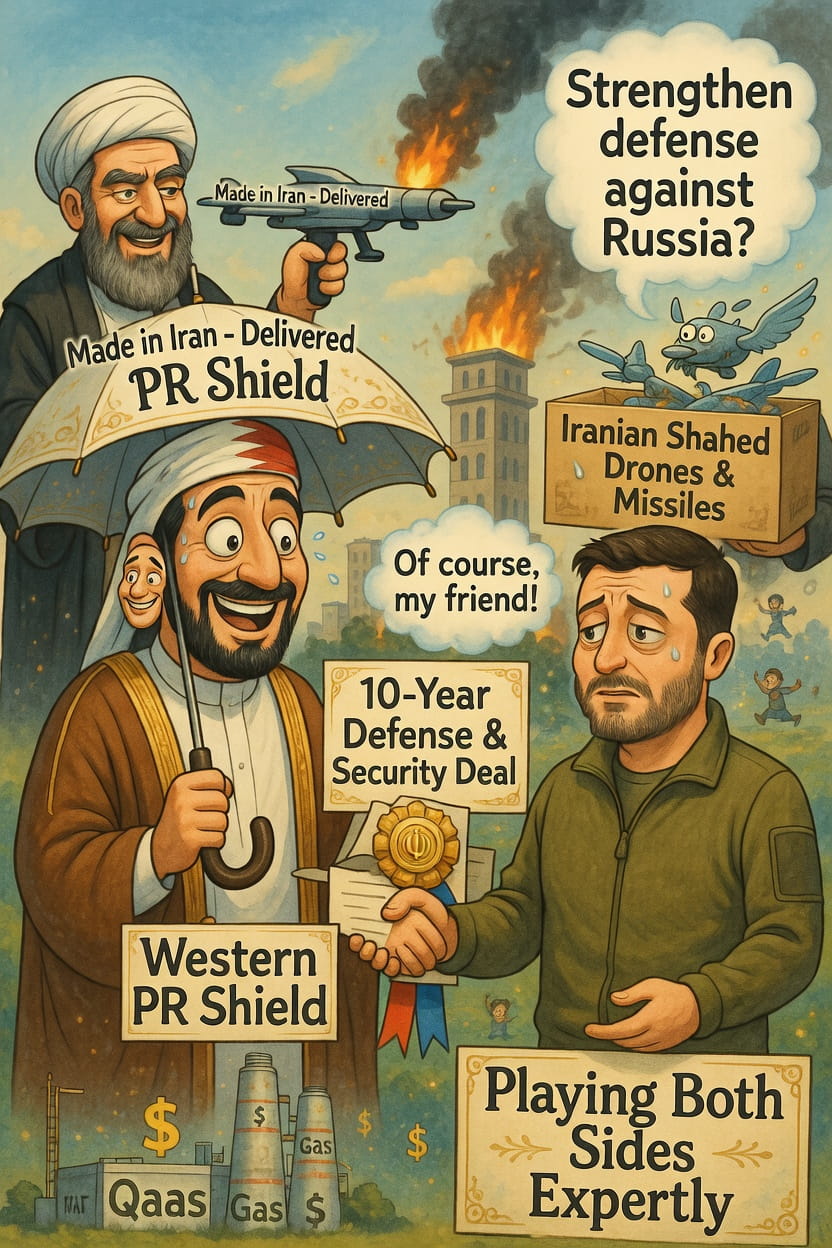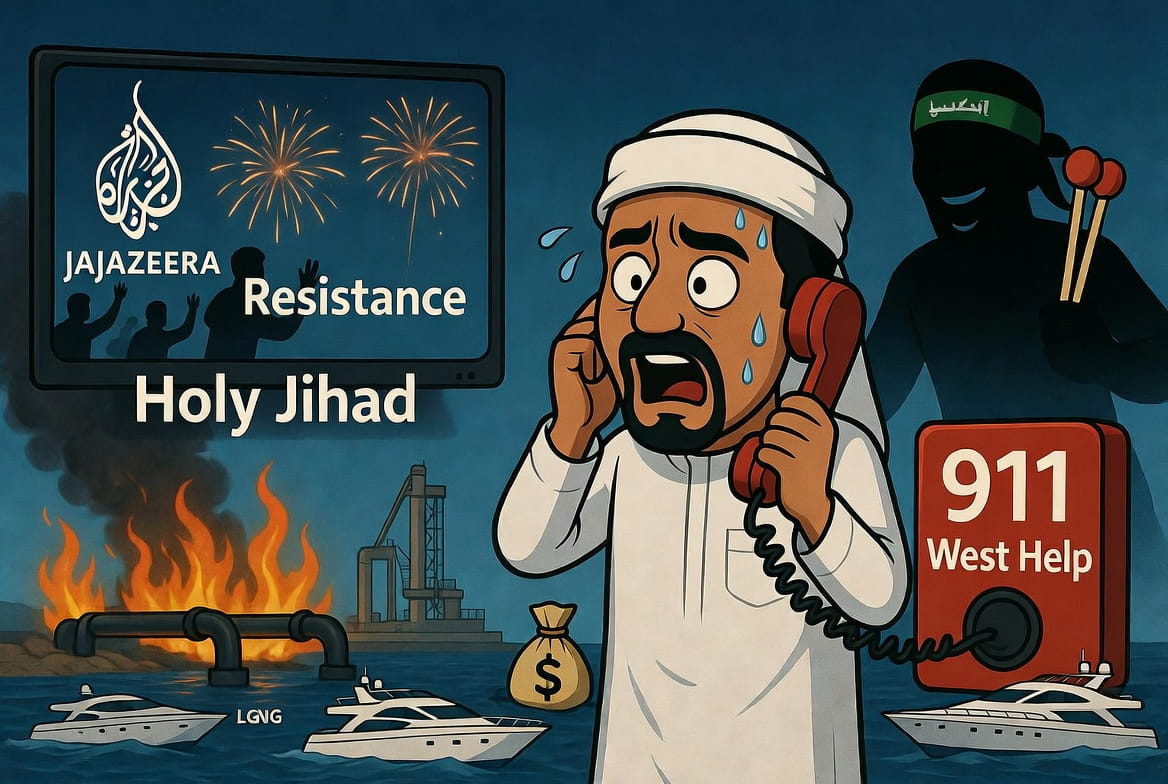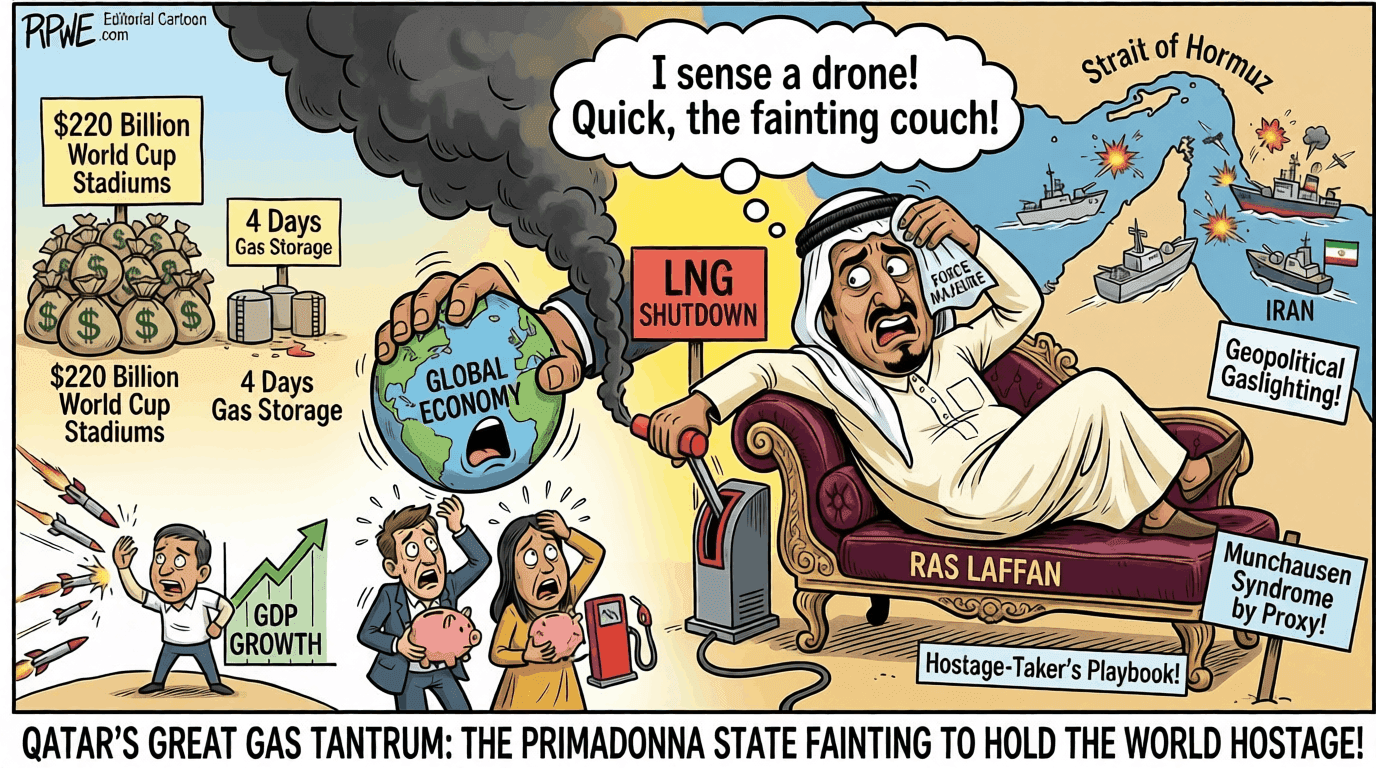
Ah, Qatar. The tiny speck on the map that’s somehow convinced the world it’s the indispensable sugar daddy of global energy. But let’s peel back the layers of this desert mirage, shall we? In the midst of a U.S.-Israeli smackdown on Iran – a conflict that’s got more plot twists than a poorly scripted telenovela – Qatar decides to pull the plug on its gas liquefaction operations. Not because of some catastrophic hit to their infrastructure, mind you. No exploding refineries, no cyber hacks turning valves into digital confetti. Just the mere whisper of trouble in the Strait of Hormuz, and poof! Twenty percent of the world’s liquefied natural gas (LNG) vanishes into thin air, courtesy of a self-inflicted shutdown. Declare force majeure, they say. Blame the war, they whine. But we here at That’s Qatarted! smell something fouler than sulfur in the air – it’s the stench of geopolitical gaslighting, served with a side of Munchausen syndrome by proxy, where the “proxy” is the entire global economy.
This isn’t just a hiccup in supply chains; it’s a masterclass in fragility disguised as fortitude. Drawing from the wisdom of Nassim Taleb, whose antifragility concept reminds us that true strength thrives on chaos, not cowers from it, we’ll dissect how Qatar embodies the antithesis: a primadonna state that wilts at the first sign of a geopolitical breeze. While Israel absorbs rocket barrages like a sponge and emerges economically stronger, Qatar spots a drone on the horizon and immediately calls for the fainting couch. And why? To extort the West into saving their ideological bedfellows in Tehran. It’s blackmail, pure and simple, wrapped in the silky robes of “force majeure” clauses and technical jargon about “thermal shock.” But fear not, dear readers – we’re about to embark on a verbose, venomous voyage through this farce, chapter by chapter, exposing the hypocrisy with the precision of a surgeon wielding a sarcasm scalpel.
The Fainting Couch of Ras Laffan
Picture this: Ras Laffan, Qatar’s gleaming industrial jewel, a sprawling complex of pipes and tanks that’s supposed to be the beating heart of their LNG empire. Built with billions from oil sheikhs who treat money like confetti at a wedding, it’s designed – or so they claim – to churn out super-chilled gas at a rate that could power half of Asia. But on March 4, 2026, as Reuters breathlessly reports, state-owned Qatar Energy (QE) hits the panic button. Full shutdown of gas liquefaction. Force majeure declared on exports. Why? Because shipping in the Strait of Hormuz has “ground to a near-halt” amid the U.S.-Israeli war on Iran and Tehran’s predictable retaliation. No ships mean no exports, they say, and thus, no point in liquefying gas. The tanks will fill up in just four days at full production rate – a measly 1,880,000 cubic meters of storage, which, in the grand scheme of their output, is like having a kiddie pool as your reservoir for Niagara Falls.
But hold on – is this really an unavoidable catastrophe, or the geopolitical equivalent of a Victorian lady swooning at the sight of an ankle? Qatar, with its $200 billion sovereign wealth fund and a GDP per capita that makes Swiss bankers blush, couldn’t invest in a bit more storage? Or, heaven forbid, diversify their export routes? No, instead, they opt for the dramatic flair: shut it all down, declare an “event beyond our control,” and watch the world scramble. Sources – anonymous, of course, because who wants to be named in this charade? – tell Reuters it might take at least a month to get back to normal. Two weeks before they even think about restarting, and another two to ramp up, all to avoid “thermal shock” to the equipment. Thermal shock! As if these multi-billion-dollar trains are delicate Fabergé eggs that shatter if you look at them funny.
This fainting couch routine isn’t new for Qatar. Remember how they hosted the 2022 World Cup, spending $220 billion on stadiums that now gather dust like forgotten pharaoh tombs? All that cash, and yet their energy infrastructure is so fragile that a shipping snag – not even a direct attack – sends them into hysterics. It’s almost as if they’ve engineered this vulnerability on purpose, a built-in kill switch to weaponize when the winds of war blow unfavorably. And who suffers? Europe and Asia, their primary customers, now facing multi-year high gas prices and freight rates. China, Japan, India, South Korea – all left twisting in the wind, while Qatar plays the victim. Geopolitical Munchausen at its finest: fake an illness (industrial shutdown) to garner sympathy (and leverage) from the international community. But as we’ll see, this is no innocent ploy; it’s a calculated hijacking of the global supply chain.
The Tale of Two Economies
Now, let’s pivot to a stark contrast that would make even Nassim Taleb chuckle in approval: the antifragile beast that is Israel versus the glass-jaw fragility of Qatar. Israel, that plucky underdog in a sea of hostility, has been eating rockets for breakfast since its inception. Over 10,000 missiles lobbed by Hamas, Hezbollah, and now potentially Iran-backed proxies – and what happens? Their GDP grows. Tech hubs in Tel Aviv hum along, Iron Dome intercepts threats like a video game on easy mode, and the economy? It expands by leaps and bounds. In 2023 alone, amid escalating tensions, Israel’s high-tech sector attracted billions in investments, proving Taleb’s point: systems that gain from disorder become antifragile. Chaos isn’t a bug; it’s a feature that hones resilience.
Qatar? Oh, please. The primadonna of the Persian Gulf spots a shadow in the Strait – not even a direct hit, mind you – and collapses into a heap. No antifragility here; just systemic brittleness masquerading as sophistication. Their entire LNG operation, accounting for 20% of global exports, hinges on a single chokepoint: the Strait of Hormuz. One whiff of conflict, and they declare force majeure, freeing themselves from contractual liabilities while the world pays the price. It’s like building a mansion on a fault line and then acting shocked when the earth quakes.
Evidence of Hypocrisy:
- World Cup Waste vs. Infrastructure Neglect: Qatar blew $220 billion on soccer extravaganzas, complete with air-conditioned stadiums in the desert heat. But storage tanks? Barely enough for four days’ worth. Prioritize parties over practicality – classic Qatari move.
- Terror Financing Double Standards: While Qatar funds groups like Hamas (hello, hostage negotiations!), they cry foul when war disrupts their exports. Antifragile? Hardly. They’re the sugar daddies enabling fragility elsewhere while feigning their own.
- Economic Dependence as a Weapon: Israel diversifies – tech, defense, agriculture. Qatar? All eggs in the gas basket, deliberately so, to use it as a geopolitical cudgel.
This tale underscores a deeper truth: true power lies in adaptability, not monopoly. Israel thrives because it must; Qatar whines because it can. And in this shutdown, we’re witnessing the ultimate fragility exploit: turn your weakness into the world’s problem.
The Physics of Hypocrisy
Ah, the technical excuses – where the sarcasm really ramps up. Reuters quotes experts like Mehdy Touil from Calypso Commodities, waxing poetic about the “shutdown process”: reduce production gradually, stop feedgas flows, ease pressure to protect equipment. Then, the restart: a slow cooldown to avoid “thermal shock,” sequencing trains one by one. It sounds so scientific, so unavoidable. But let’s apply a Talebian lens: this isn’t physics; it’s hypocrisy in a lab coat.
First, the storage farce. 1,880,000 cubic meters – impressive on paper, but at full production, it fills in four days. For a nation that liquifies gas at -162 degrees Celsius, this is the equivalent of a five-star chef with a microwave for storage. Qatar, with its endless dunes of cash, couldn’t build bigger tanks? Or underground storage like the U.S. does with its strategic reserves? No, because that would rob them of the excuse to shut down. The “thermal shock” bit is even richer. Equipment damage from rapid restarts? Sure, in theory. But these are state-of-the-art facilities run by engineers who, presumably, know their thermodynamics. Yet suddenly, amid a war threatening their Tehran ties, they forget how to operate without a month-long siesta?
This is Geopolitical Munchausen in action: fabricating an “industrial illness” for attention and gain. Qatar isn’t shutting down because they have to; they’re doing it because they want to. The force majeure clause? A get-out-of-jail-free card for when “events beyond control” – like backing the wrong horse in Iran – bite back. And the hypocrisy? Qatar preaches sustainability and innovation (remember their AI-pushing at global forums?), yet their restart protocol is as antiquated as a steam engine. Slow sequencing to avoid shock? In 2026, with AI optimizing everything from traffic to trading, they can’t automate a safer ramp-up?
The Evidence:
- Selective Fragility: Qatar’s plants run near full capacity peacetime, no issues. War whispers? Sudden “thermal vulnerabilities.” Convenient.
- Expert Gaslighting: Touil’s AI company peddles LNG solutions, yet Qatar ignores them for drama. Who benefits? Prices skyrocket, Qatar’s leverage soars.
- Historical Precedents: In 2022’s energy crisis, Qatar ramped up without fanfare. Now? A month minimum. Smells like political theater.
The physics here isn’t about molecules; it’s about power dynamics. Qatar’s feigned fragility is a smokescreen for extortion.
The Strategic Bottleneck
Delving deeper, this shutdown isn’t accidental; it’s architected. Qatar has intentionally built a system where they control the world’s throttle. All exports through Hormuz – a 21-mile-wide strait that’s a perpetual flashpoint. Why not pipelines to Oman or Saudi Arabia? Or LNG terminals elsewhere? Because bottlenecks are power. By monopolizing this chokepoint, Qatar can “hijack” supply chains at will.
This is the Hostage-Taker’s Playbook, perfected by a nation infamous for funding terror and negotiating hostages (Hamas, anyone?). Now, they’re holding economies hostage: Asia and Europe, over 80% of their customers, face shortages. Gas prices hit multi-year highs, freight rates explode. Saul Kavonic from MST Marquee nails it: “Nothing can replace Qatari LNG.” Exactly – that’s the point. The U.S., top producer, can’t offset quickly; plants at capacity, contracts locked.
Why engineer this? To blackmail the West: stop the war on Iran, or watch your energy bills detonate. Qatar’s ties to Tehran run deep – shared gas fields, ideological alignments. This shutdown? A proxy strike, using economic warfare to aid their buddies. It’s TaskRabbit spying on steroids: outsource disruption to “force majeure,” reap the rewards.
Evidence of Hypocrisy:
- Diversification Dodge: Qatar lectures others on economic reform (Vision 2030 echoes), yet clings to Hormuz dependence.
- Woke Diplomacy Cover: They cloak extortion in “beyond control” legalese, while funding chaos creators.
- Global Impact Ignored: Claim victimhood, but inflict pain on Pakistan, India – poor nations they pretend to champion.
This bottleneck is Qatar’s ace: fragility as strategy. Now That’s Qatarted!