Let’s dismantle the geopolitical smoke-and-mirrors show for a second. If you believe the press releases coming out of Doha, January 2026 was the moment Qatar, the gas-rich enabler state, donned a cape and saved the Middle East from a fiery, kinetic apocalypse. The narrative is slick, polished, and smells faintly of expensive oud and desperation: The U.S. was moments away from turning Iranian military sites into parking lots, and the brave Honest Brokerstm in Doha swooped in to cool the tempers of the American war machine.
But let’s be real. This wasn’t a peace mission. This was a rescue operation for a regime on the ropes.
Welcome to the Preservation Paradox. Qatar isn’t buying peace; they are buying time for their ideological cousins in Tehran. While the West celebrates “de-escalation,” the reality is much uglier: Qatar just successfully lobbied to keep the world’s leading sponsor of terror in business, effectively jamming a doorstop in the face of secularization and regime change.
The PR Spin: “The Firefighters of the Gulf”
Picture the scene: It’s early 2026. The U.S. military is locked and loaded, ready to deliver a “decapitation strike” on Iranian soil. The “grave blowbacks” are looming like a bad hangover. Enter Qatar, flanked by a nervous Saudi Arabia and Oman, clutching their pearls and sprinting toward Washington with a message of frantic benevolence.
The official story is heartwarming enough to make a defense contractor cry. The coalition’s goal? To secure a “chance to show good intention” for the Iranian regime. They weren’t protecting the Mullahs. Oh noooooo, They were just worried about “regional continuity” and preventing a “multi-front conflagration”.
They sold this intervention as a necessity of statecraft, a “last-minute effort” to pull the region back from the brink. They leveraged their “unique access” to the Trump administration to argue that bombing the Ayatollahs would ruin the “current good spirit” of the neighborhood. “Give peace a chance,” they whispered, while frantic back-channel messages flew through Pakistan like carrier pigeons on meth.
It worked. The kinetic phase was delayed. The Tomahawks stayed in the tubes. And Doha patted itself on the back for saving the world.
The Receipts: A frantic Scramble to Save the Brand
Let’s look at the data, because the timeline tells a story that the press releases conveniently omit.
The Panic Button: This wasn’t cool-headed diplomacy; it was a “frantic” offensive. Qatar engaged in “high-frequency” communications with the U.S. executive level, practically begging them to stand down.
The “Ultimatum” Farce: The big win was relaying a message that Trump “did not want war”. The condition? Iran just had to promise not to hit “U.S. interests”. That’s it. No regime change, no dismantling of the terror apparatus, just a pinky promise to aim the missiles slightly to the left of American assets.
The Base Shuffle: To prove the U.S. had backed down, the Pentagon returned forces to the “previously evacuated” base in Qatar. This validated Qatar’s role as the indispensable host, proving that you can harbor the arsonist’s best friends while housing the fire department.
The Israeli Pivot: Even Netanyahu was roped in, urging Trump to “hold off,” likely creating the “political density” Qatar needed to sell the retreat as a consensus move.
The Reality: Dictator Insurance Premium
Now, flip the script. Why was Doha so terrified of a U.S. strike on Iran?
They’ll tell you it’s about “maritime and economic interests”. They’ll say a war would threaten the Gulf’s shiny skylines. But the Security Paradox bites hard here too. Qatar didn’t intervene because they care about Iranian civilians; they intervened because the fall of the Islamist regime in Tehran is a direct threat to the Pan-Islamist brand Qatar has spent billions cultivating.
Qatar is the “5-Star Concierge for Theocracy.” Their entire foreign policy model is based on being the bridge between the civilized world and the guys who want to burn it down. If the Iranian regime collapses and is replaced by a secular, pro-Western government, Qatar loses its leverage. They lose their unique access. They become just another small peninsula with a lot of gas and nothing to offer Washington.
The intervention wasn’t about saving lives; it was about Regime Preservation.
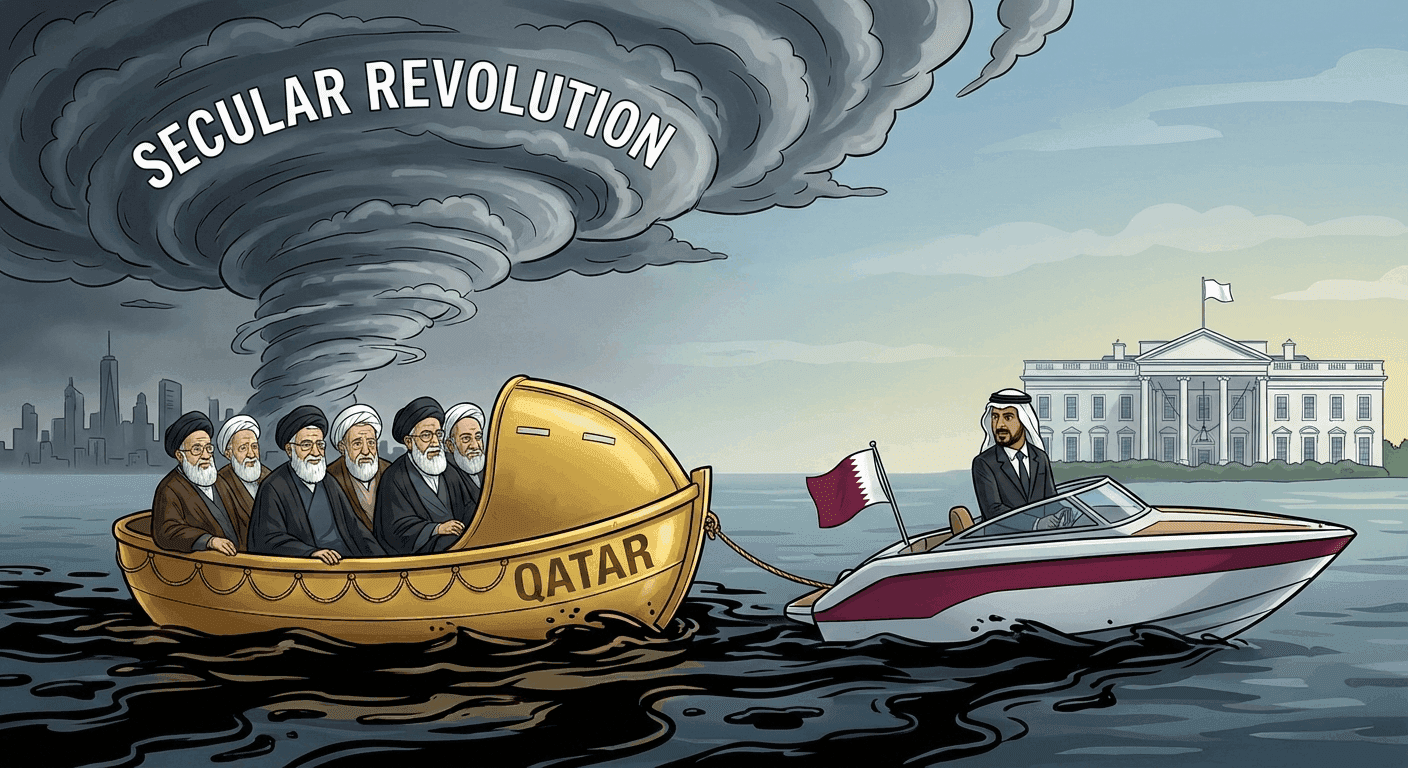
Look at the internal context. While Qatar was begging Trump to stop, the Iranian regime was busy crushing domestic unrest. Tehran “claimed control” of protests just as the de-escalation deal was struck. A U.S. strike at that moment could have been the catalyst for a secular revolution, the final push the Iranian people needed to topple the Mullahs.
Qatar saw that possibility and panicked. By securing a “diplomatic off-ramp”, they gave the Ayatollahs exactly what they needed: a win. A moment to breathe. A “monitored window of behavioral calibration” that allows them to regroup, re-arm, and get back to business as usual.
The “Good Intention” Scam
The most nauseating part of this charade is the language. Qatar and its coalition urged the U.S. to trust in Iran’s “good intention”.
Let that sink in. Good intention. From a regime that has spent decades executing dissidents and funding proxy wars. Qatar asked the U.S. to pivot from deterrence to a “good intention paradigm”. It’s the diplomatic equivalent of asking the police to let a serial killer go because he promised to start a yoga journal.
And it worked! The U.S. accepted the premise. They traded a decapitation strike for a so-called wait and see approach. They bought the lie that a temporary pause in hostilities could be transformed into a “resilient framework”.
But who actually benefits from this framework?
The Mullahs: They survive. They tell their people, “Look, the Great Satan blinked.” They confirm via their envoy in Pakistan that the immediate threat is gone.
Qatar: They cement their status. They prove that without Doha, the region burns. They “consolidate gained trust”, ensuring the U.S. remains dependent on their back-channels forever.
The Islamists: The status quo remains. The secularizing forces within Iran are left isolated, watching as the free world cuts deals with their oppressors, brokered by their neighbors in Doha.
The Ecosystem of Complicity
This is Hard Influence masking itself as peacemaking. Qatar leveraged the “current good spirit” to gaslight the Trump administration into believing that striking Iran was a bad business move.
They used the complexity of the situation, the domestic ICE protests in Minnesota, the threat of the Insurrection Act in the U.S., to convince a distracted White House that a foreign war was too much hassle. “Why bother fighting,” Doha whispered, “when we can just manage the chaos for you?”
This is the Qatari playbook perfected. They don’t solve problems; they manage them in perpetuity. They need the threat of Iran to remain just below the boiling point. If the threat vanishes (via regime change or peace), Qatar’s phone stops ringing. If the threat explodes (via war), Qatar’s investments get singed.
So they engineered the “Goldilocks Zone” of terror: Not too hot, not too cold. Just dangerous enough to keep the U.S. hooked on Qatari mediation, but safe enough to keep the gas exports flowing.
Conclusion: The Mullah’s Life Raft
In the end, the “Regional Preservation” Qatar boasts about is really just the preservation of an archaic, brutal ideology. They successfully utilized “non-traditional conduits” to save the Iranian regime from the consequences of its own actions.
They will call it stability. They will call it “consolidating trust”. But let’s call it what it is: Theocracy Life Support.
Qatar looked at the potential for a secular, free Iran and saw a threat to their business model. So they rushed to Washington, cashed in their favors, and bought the Mullahs another year, another decade, another lifetime.
The West thinks it dodged a bullet in January 2026. In reality, we just reloaded the gun and handed it back to the guys in Tehran, with a thank-you note signed by Doha.
That’s not diplomacy. That’s an accessory to the crime.